
Porsche Cayenne Turbo GT Coupe (PO536) Tuning Guide 2026 — Body Kits, Wheels & Performance


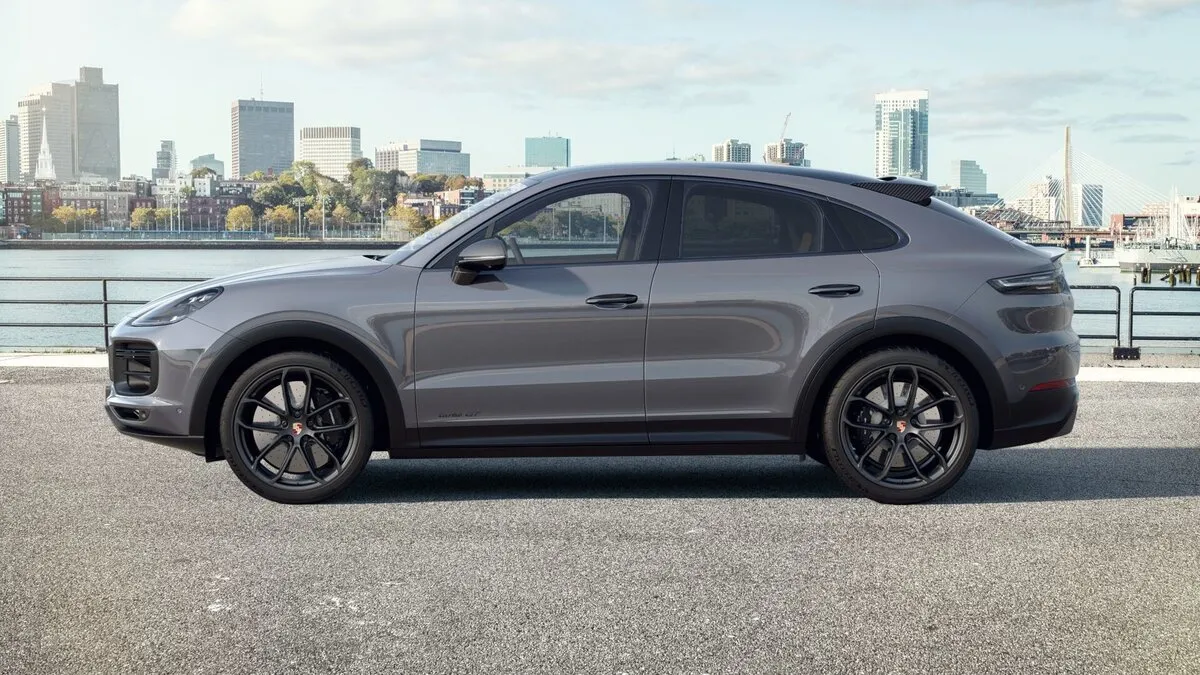
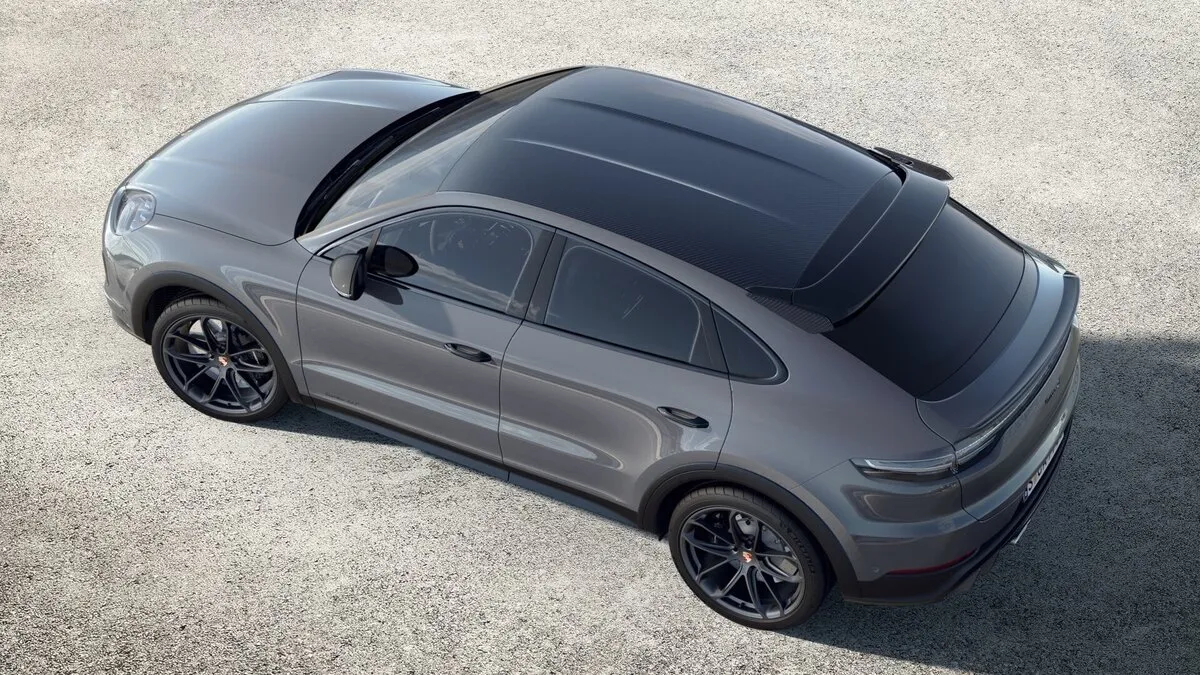
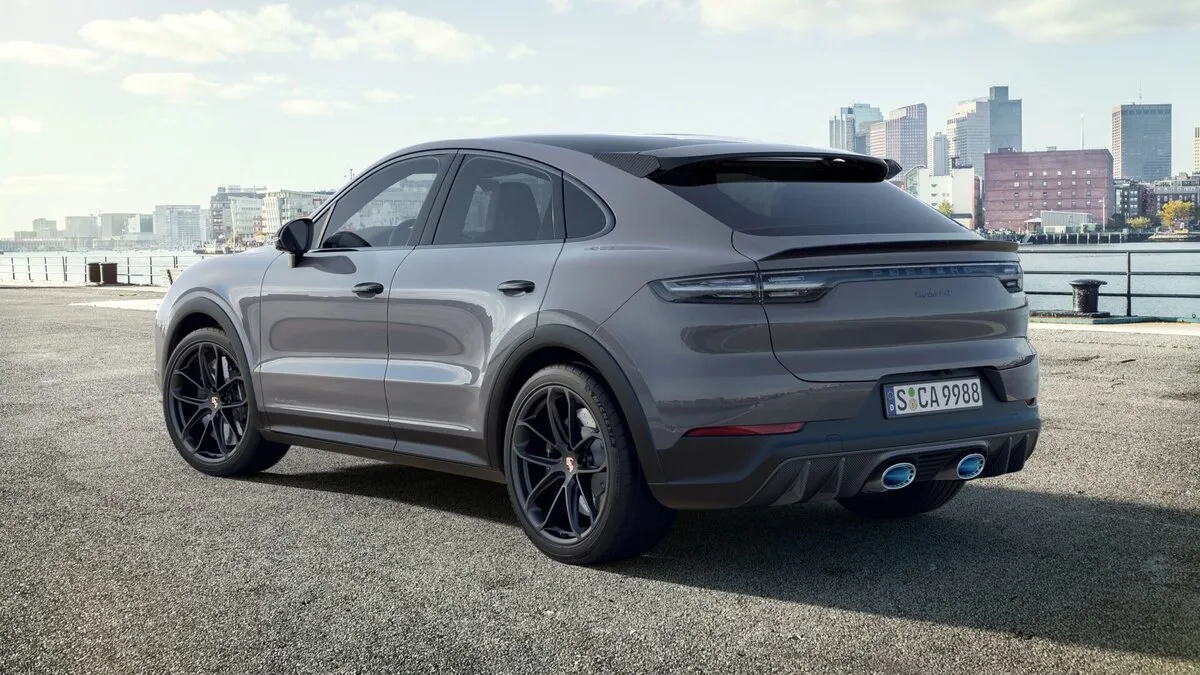
The Porsche Cayenne Turbo GT Coupe (PO536) is the track-focused, Coupe-only flagship of the third-generation Cayenne line — launched in 2022 as Porsche's direct answer to the Lamborghini Urus Performante. It set a benchmark production-SUV Nürburgring Nordschleife lap of 7 minutes 38.9 seconds in the hands of Porsche factory driver Lars Kern, making it at the time the quickest SUV ever to lap the Green Hell. Unlike the standard Cayenne Turbo Coupe, the Turbo GT is offered in Coupe bodystyle only, comes with a four-seat configuration (center rear seat deleted), rides on a unique 17 mm-lower Nürburgring-tuned PASM three-chamber air suspension, fits an uprated PDCC 48V active anti-roll system, a titanium Sport Exhaust System, Porsche Ceramic Composite Brakes (PCCB), 22-inch forged wheels, carbon front splitter and carbon roof — and the 4.0 L twin-turbo V8 EA825 is re-engineered to produce 650 hp and 850 Nm. This guide covers every meaningful upgrade for the Turbo GT — TechArt, Manhart, Mansory, Lumma, Akrapovic and KW — and explains which modifications preserve the car's rare-halo value and which destroy it.
Porsche Cayenne Turbo GT Coupe Specifications (PO536, 2022+)
Platform Overview — MLB Evo + Turbo GT-Specific Nürburgring Calibration
The Turbo GT Coupe rides on Volkswagen Group's MLB Evo longitudinal modular architecture — the same platform that underpins the Audi Q7 4M, Audi Q8 4M, Bentley Bentayga, Lamborghini Urus and VW Touareg CR. That shared DNA is a gift for tuners: parts, geometry knowledge and suspension tuning developed for one MLB Evo derivative carry across to the others. But the Turbo GT is not a trim level — it is a fundamentally re-engineered car. Porsche's chassis team ran the entire development programme at the Nürburgring, and the delta to the standard Turbo Coupe is deep. The PASM three-chamber air suspension uses Turbo GT-specific damper valving and firmer spring rates, and sits 17 mm lower than Turbo Coupe Sport-lowered. Porsche Dynamic Chassis Control (PDCC) 48 V active anti-roll bars are standard and use firmer roll-rate maps than on other Cayennes. Porsche Torque Vectoring Plus (PTV+) pairs with an electronically locking rear limited-slip differential, and rear-wheel steering is standard (not optional as on Turbo Coupe).
The 4.0 L twin-turbo V8 EA825 gets its own Turbo GT calibration — new turbochargers with uprated compressor wheels, reinforced crankshaft, revised piston crown cooling, and a dedicated ECU map delivering 650 hp at 6,500 rpm and 850 Nm from 2,300-4,500 rpm. The factory exhaust is a genuine titanium Sport Exhaust System (not a stainless-steel with titanium trim — the muffler housings themselves are Grade 2 titanium), saving approximately 17 kg over the Turbo Coupe's steel system. The Porsche Ceramic Composite Brakes (PCCB) are standard not optional — 440 mm front rotors with 10-piston aluminium mono-block calipers, 410 mm rear — and the wheels are unique Turbo GT-branded 22" forged in staggered 10 J ET28 / 11.5 J ET40 fitment. The Coupe-only four-seat interior with PCCB, carbon-shell seats and Alcantara roof lining saves a further 30+ kg over a regular Turbo Coupe spec.
Porsche Cayenne Turbo GT Coupe Body Kits
TechArt GT Coupe TG & GTsport Widebody — The Dominant Porsche Tuner
TechArt of Leonberg, Germany is the historic Porsche specialist — the company has tuned every 911 generation since the 1980s — and its Turbo GT programme is the single most complete in the aftermarket. The flagship is the TechArt GT Coupe Turbo GT body package: a bolt-on carbon kit with a reshaped front bumper incorporating larger central and side intakes, carbon air-flic elements, widened front and rear arches, side-skirt extensions, a carbon rear diffuser integrating the factory Turbo GT quad tailpipes, and a TechArt-specific fixed carbon rear wing that complements the factory adaptive spoiler. The more extreme TechArt GTsport is a full widebody conversion — the front and rear fenders are cut and replaced with bonded composite panels, pushing total width out by roughly 60 mm and accepting 22x11 ET28 / 22x12 ET40 wheel fitments. Both kits are TÜV-approved in Germany and available in visible-weave carbon or painted composite. TechArt also offers Formula VII forged wheels matched to the Turbo GT chassis geometry.
Manhart MH10 — 750 hp Stage 2 Power Programme
Manhart Performance of Wuppertal, Germany — best known for its BMW M and Mercedes-AMG programmes — runs the most visible power-focused Turbo GT build. The Manhart MH10 package is a Stage 2 ECU and TCU flash plus intake upgrades lifting the 4.0 V8 EA825 to 750 hp and 950 Nm (+100 hp / +100 Nm over stock) while retaining the factory titanium exhaust and factory transmission internals. Manhart pairs the tune with its own aero: carbon front lip inserts, side blades, carbon rear lip spoiler and a subtle roof-mounted wing. Manhart MH10-branded forged 22-inch wheels in gold, black or Manhart-signature grey complete the build. The full MH10 package — ECU, aero, wheels, H&R lowering springs, interior appliqué — typically sits €45,000-60,000 above the donor Turbo GT and is delivered with Manhart warranty and full dyno documentation. Manhart is our first recommendation where outright power is the priority.
Mansory Turbo GT — Full Forged-Carbon Re-Skin
Mansory of Brand, Germany takes the opposite approach to TechArt's Porsche-purist aesthetic. The Mansory Cayenne Turbo GT Coupe is a full carbon body re-skin where almost every exterior panel is replaced with gloss or matte visible-weave carbon — new front bumper with forged-carbon intakes, carbon hood with functional vents, full carbon fender flares pushing total width outwards, carbon side skirts, a dramatically sculpted carbon rear bumper with integrated quad exhausts, and Mansory's signature forged-carbon roof panel (replacing Porsche's factory carbon roof with a more visible-weave item). Paint options are unlimited and bespoke. Mansory typically pairs the body with its own forged 22 or 23 inch wheels and a Mansory ECU calibration taking the V8 close to 820 hp. Pricing is GCC and Russia dominant — a full Mansory Turbo GT Coupe build typically lands €150,000-220,000 above the donor car.
Lumma CLR 750 SV — Winnenden Widebody for the Turbo GT
Lumma Design of Winnenden, Germany has been the mid-tier widebody specialist on the Cayenne platform since the original 955 generation, and the CLR 750 SV programme re-engineered for the Turbo GT Coupe is its latest. The kit widens the arches through bonded composite overfenders (roughly 40 mm per side), adds a reshaped front bumper with split lower splitter that retains the factory Turbo GT brake cooling ducts, side-skirt extensions, a rear bumper with integrated diffuser that clears the factory titanium quad exhaust, and Lumma's fixed carbon rear wing. Lumma pairs the kit with its own Lumma CLR 22 forged monoblock wheels in 22x10.5 / 22x11.5 staggered fitment. The CLR 750 SV is the middle ground — more aggressive than TechArt's GT Coupe TG kit but less expensive than Mansory's full carbon re-skin — and it is the commercial sweet spot for Russian, CIS and Baltic market Turbo GT owners.
Bisimoto Engineering, BBM Motorsport & Brembo CCM-R Specialists
In the US, Bisimoto Engineering (Ontario, California) runs the most visible domestic Turbo GT programme — a Stage 2 calibration with upgraded intercoolers and a Bisimoto-branded carbon aero package, with deliveries focused on California and Florida. BBM Motorsport (Germany) specialises in motorsport-level brake and driveline upgrades for track-campaigned Turbo GTs, including Brembo CCM-R carbon-ceramic rotors that replace even the factory PCCB for customers running the car hard at circuit events. Mov'It offers a 10-pot big brake kit as an even more extreme alternative. None of these specialists match TechArt or Manhart's depth of body-kit engineering, but each is a legitimate alternative where availability, price or track-specific performance dictates.
Porsche Cayenne Turbo GT Coupe Wheels — 22" Forged (and 23" with Caveats)
Factory wheels on the Turbo GT are unique 22-inch forged monoblocks in staggered 10 J ET28 front / 11.5 J ET40 rear fitment, wrapped in Pirelli P Zero Corsa PZC4 285/35R22 front and 315/30R22 rear (N0-rated for Porsche) — or the optional Michelin Pilot Sport Cup 2 N-spec for track-focused owners. This wheel-tyre package was developed specifically for the Nürburgring 7:38.9 lap and is part of why the car turns in as sharply as it does. The aftermarket sweet spot is to stay at 22 inch and simply upgrade to a lighter forged wheel: TechArt Formula VII (22x10 ET28 / 22x11.5 ET40, roughly 11.8 kg per corner — lighter than factory), Vorsteiner V-FF 107 flow-formed or V-VS 310 full forged, HRE P101 forged monoblock, ANRKY RS1 forged three-piece, and ADV.1 ADV5.3 forged. All accept the factory 285/30 and 315/30 Pirelli PZC4 or Michelin Cup 2 N-spec fitment without modification.
Going up to 23-inch (Mansory, ANRKY S3-X3 forged three-piece) is possible but comes with real compromise. The Turbo GT's Nürburgring-tuned chassis geometry — damper valving, spring rates, anti-roll calibration — was optimised around the factory 22-inch wheel-tyre package, and fitting 23 inch tyres reduces sidewall from 85-95 mm down to 70-80 mm. That stiffens ride quality on less-than-perfect surfaces and, more importantly, shifts the car's handling balance away from Porsche Weissach's intended calibration. For show builds or smooth-road use, 23 inch is viable. For owners who want to preserve the car's track-focused character and Nürburgring-inspired ride, 22 inch staggered forged is the correct answer. Winter tyres — Michelin Pilot Alpin 5 SUV or Nokian Hakkapeliitta R5 SUV — should be fitted in dedicated 21-inch staggered wheels.
Porsche Cayenne Turbo GT Coupe Performance — Stage 1 to 750 hp & Akrapovic Evolution
The factory 650 hp calibration has genuine headroom — the EA825 V8 is shared across the Turbo Coupe (550 hp), Turbo GT (650 hp), Audi RS Q8 (600 hp) and the Lamborghini Urus Performante (666 hp), and the hardware in the Turbo GT is already the strongest of the family with uprated turbos and reinforced internals. TechArt Stage 1 via the TechArt VarioPlus 3 module or an MHD-style OBD flash lifts output to approximately 720 hp and 920 Nm (+70 hp / +70 Nm) while retaining full factory warranty compatibility and being reversible at the ECU level. Manhart MH10 Stage 2 reaches 750 hp and 950 Nm with higher boost pressure, upgraded intercoolers, and a reworked TCU map for gearbox torque acceptance — this is the highest reliable power level we recommend for a Turbo GT intended to see track use. Mansory's map pushes higher (~820 hp) but requires careful exhaust and cooling upgrades to sustain duty cycles. Bisimoto in the US offers a similar Stage 2 tier with upgraded intercoolers at ~750 hp.
Exhaust options are the second major upgrade lever. The factory titanium Sport Exhaust System is already Grade 2 titanium from the muffler housings rearward — replacing it is an aesthetic or acoustic choice more than a weight-saving one. The Akrapovic Evolution line for the Turbo GT is a full race-spec titanium system with larger-bore piping, straight-through race-style mufflers and valve-controlled tips — it replaces the factory titanium system with an even lighter and louder item, and is Porsche's own factory-collaboration brand. iPE Innotech (Taiwan) is the cheaper titanium alternative with similar valve hardware. Capristo (Germany) builds valve-controlled systems with the most aggressive straight-through sound. Soul Performance Products (US) is the boutique alternative. Suspension upgrades beyond the Turbo GT's factory Nürburgring calibration are rarely needed — PASM, PDCC, rear steer and PTV+ are already track-optimised — but KW HLS 4 hydraulic front-axle lift kit is a genuine utility upgrade (retrofits on factory air suspension to lift the front axle 55 mm at the touch of a button for speed bumps and steep driveways), TechArt VarioPlus 3 remaps the damper curves, and H&R rear anti-roll bar is the only meaningful chassis-balance tweak.
Porsche Cayenne Turbo GT Coupe Brakes — PCCB, Brembo CCM-R & Mov'It 10-Pot
The Turbo GT ships with Porsche Ceramic Composite Brakes (PCCB) as standard — 440 mm front rotors with 10-piston monoblock calipers and 410 mm rear. For street driving this package is essentially limitless — PCCB rotors resist fade and last tens of thousands of km under normal use. Track use is a different calculation. PCCB rotors cost €5,000-7,000 per rotor at replacement and are consumable items under sustained track abuse. Dedicated track-day owners typically upgrade to Brembo CCM-R racing carbon-ceramic rotors — these use a different ceramic matrix with longer thermal endurance and are the factory brake on the Porsche 911 GT2 RS and GT3 RS. The Mov'It 10-pot big brake kit is the alternative for owners who want to go even further — a full steel rotor and 10-pot caliper setup designed for endurance-racing duty cycles. Pad strategy for track days: swap factory PCCB pads for Pagid RSL29 or Ferodo DS2500 race compounds on event weekends, return to OE pads for street use.
Porsche Cayenne Turbo GT Coupe Interior
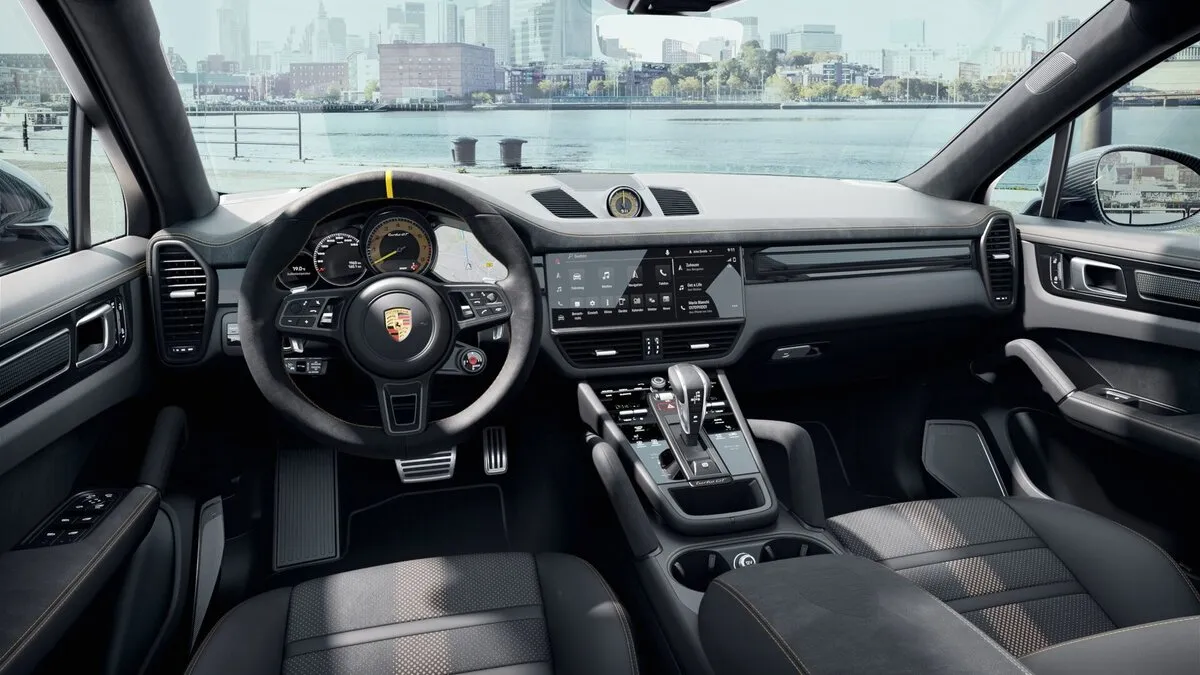
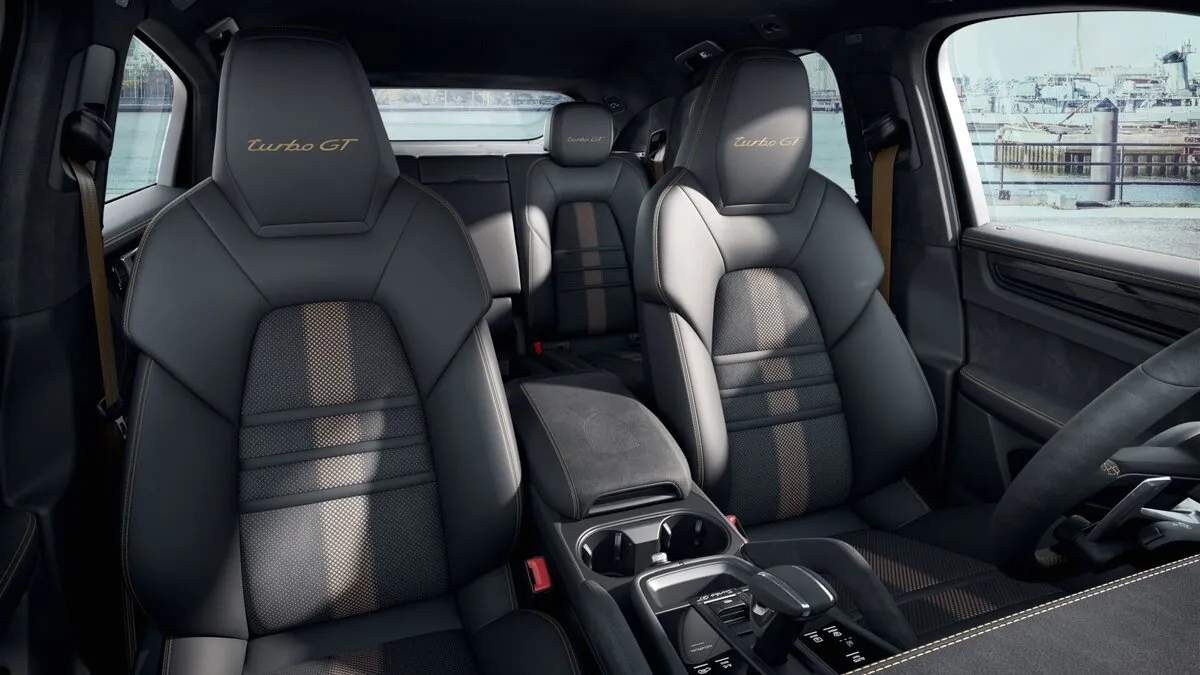
The Turbo GT cabin is four-seat only — the centre rear seat is deleted in favour of a central tunnel — with 18-way electrically adjustable carbon-shell sport seats as standard, Race-Tex (Porsche's alcantara branding) upholstery throughout, contrasting Arctic Grey or Neodyme stitching, and full aluminium or forged-carbon trim. TechArt's signature interior upgrade is a TechArt Race-Tex re-trim — bespoke alcantara or leather-plus-alcantara with colour-custom stitching and embossed TechArt or owner-specified logos on the headrests. Carbon trim upgrades are offered by TechArt, Mansory and Carlex Design (Poland) — forged-carbon door cards, dashboard inserts, and centre console surrounds. An Alcantara headliner retrofit is redundant (factory already fits one on Turbo GT) but a TechArt sport steering wheel in race-Tex with carbon paddle-shifter extensions is the single most-fitted interior upgrade.
Turbo GT Resale: Why This Cayenne Holds Value
The Cayenne Turbo GT occupies a peculiar position in Porsche's SUV line-up: it is both a mass-produced Cayenne and a limited-volume halo car. Porsche has never confirmed exact production figures but industry estimates put global Turbo GT Coupe volume at 3,000-5,000 cars across the first three model years — genuine scarcity in a segment where Cayenne Turbo Coupe volumes run an order of magnitude higher. Base pricing sits at approximately £160,000 in the UK, $195,000 in the US and €185,000 in the EU. 2024-market data shows 2-year residuals holding 88-92% of list for stock Turbo GTs versus 78-82% for a comparable Turbo Coupe — the Turbo GT nameplate, four-seat carbon cabin and the Nürburgring 7:38.9 record are the halo.
Aftermarket modifications split the market sharply. Stock, lightly-specified Turbo GTs appreciate or hold value in a way that heavily tuned cars do not — Manhart MH10 750 hp builds typically lose 8-12% at resale versus a stock Turbo GT at equivalent mileage, because the collector buyer wants factory originality. Our strong recommendation is reversible modifications only: wheels (swap back to factory-issue 22" forged GT Design at resale), exhaust (keep the factory titanium system in storage), interior re-trim (Carlex or TechArt is reversible over factory), and ECU maps with documented reversion to Porsche factory calibration. Store the original wheels and exhaust. The comparison is to the Porsche 911 GT3 RS market — limited-run, nameplate-driven, where modification history decides whether a car appreciates or depreciates. The strongest resale market for stock Turbo GTs is the GCC region (UAE and Qatar), where the Nürburgring record commands a collector premium.
Frequently Asked Questions
Turbo GT Coupe vs Lamborghini Urus Pearl Capsule — which is the faster SUV?
They share the same 4.0 L EA825 V8 and MLB Evo platform, but the calibration philosophies diverge. The Urus Performante (on which the Pearl Capsule special edition is based) produces 666 hp, weighs ~2,150 kg and laps the Nürburgring in 7:42.0. The Turbo GT Coupe produces 650 hp, weighs ~2,220 kg and laps in 7:38.9 — 3.1 seconds faster despite being slightly heavier and lower on power. The difference is chassis discipline: Porsche's Weissach team tuned the PASM, PDCC, PTV+ and rear steer integration specifically around Nürburgring lap time, while Lamborghini weighted the Urus toward straight-line drama. In a straight line the Urus Performante wins by tenths; on any circuit with real corners, the Turbo GT wins consistently. For buyers who prioritise measured lap time and chassis feedback, the Turbo GT is the correct choice. For buyers who prioritise brand theatre and visual impact, the Urus.
Stock vs tuned Turbo GT — what's the real resale ratio?
Market data across 2024 auction and dealer transactions suggests that a stock, well-specified Turbo GT Coupe at 30,000 km holds approximately 88-92% of its original list price after two years, while a heavily modified Turbo GT — Manhart MH10, Mansory carbon re-skin, non-OE wheels installed permanently — loses 8-12% versus that stock baseline. The gap widens at longer hold periods. The mechanism is simple: the Turbo GT collector-buyer values the Porsche-Weissach calibration, the Nürburgring halo and the factory titanium exhaust. Any modification that breaks the factory envelope — especially visible body work or non-reversible ECU maps — narrows the buyer pool. Reversible modifications (stored factory wheels, stored factory exhaust, interior re-trim that can be reversed) preserve value. Permanent modifications (widebody carbon fenders, non-reversible tunes, deleted exhaust) destroy it. Manhart MH10 owners report the worst resale penalty in our sample.
PCCB lifespan on track days — how many events before replacement?
The PCCB rotors on the Turbo GT are genuinely excellent for street use — expect 80,000-120,000 km street life before the rotors reach minimum thickness. Track use changes the calculation dramatically. A full Nürburgring Tourist Drive day (15-20 laps at touring pace) costs roughly 3-5% of rotor life. A full track day at Hockenheim or Spa on track pads costs 5-10%. Factor in pad cost (OE PCCB pads are ~€1,500 per set and last one to two track days under hard use), rotor replacement at ~€5,000-7,000 per corner, and a dedicated track-day owner typically budgets €15,000-25,000 per year in brake consumables. Upgrade to Brembo CCM-R or Mov'It 10-pot with a dedicated track pad (Pagid RSL29 or Ferodo DS2500) is cheaper per lap of track use than running OE PCCB hardware with OE pads.
Why does the Nürburgring 7:38.9 record matter for a buyer?
More than most halo marketing numbers, actually. The Nürburgring lap establishes three concrete things for a Turbo GT buyer. First, it verifies that Porsche's entire chassis package — PASM three-chamber air with Turbo GT-specific valving, PDCC active roll, PTV Plus, rear-axle steering, PCCB, factory 22-inch forged wheels on Michelin Cup 2 N-spec tyres — works as an integrated system when pushed to limits. Second, it sets a resale floor: the nameplate and the 7:38.9 lap are what separate Turbo GT from Turbo Coupe in the used market, and are what drives the 88-92% two-year residual versus 78-82% for Turbo Coupe. Third, it provides an objective benchmark owners can test: any Turbo GT on Cup 2 tyres with a competent driver can lap the Nordschleife in a region around 8:00-8:30 — well off the factory record but faster than most cars the owner will ever share the circuit with. For GCC collectors, the record is a genuine premium factor at resale.