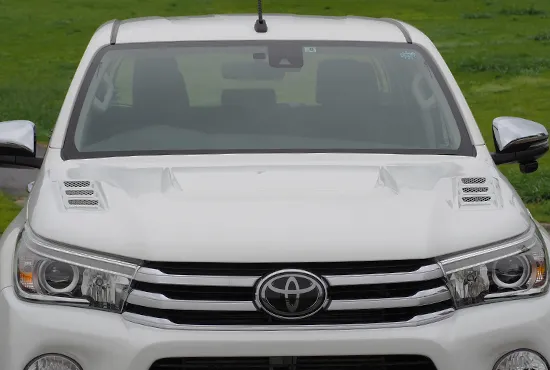
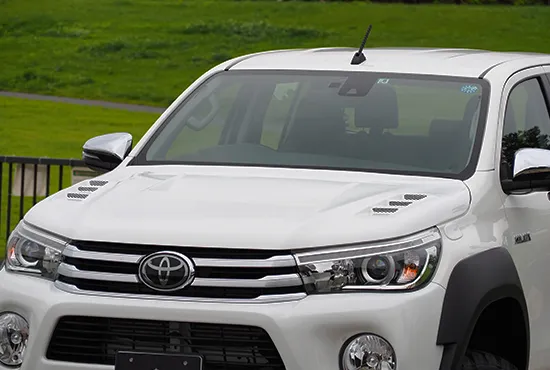
Toyota Hilux Tuning Guide 2026 — Body Kits, Wheels & Off-Road Upgrades


Toyota Hilux Tuning Guide 2026
Introduction
The Toyota Hilux has a claim that very few vehicles can make: it is arguably the most proven vehicle on earth. Sold in over 180 countries, the Hilux has been used by farmers, armies, aid organisations, and adventurers in conditions that would disable most competitors. The AN120/AN130 eighth generation (2015 to present) brings this legacy into the modern era with a significantly improved interior, updated suspension geometry, and — most importantly for the tuning market — a properly tuneable 2.8-litre diesel engine that responds well to calibration.
The Hilux's tuning market is genuinely unusual because it spans two completely different owner profiles. The first is the working owner — the farmer, contractor, or adventurer who needs genuine capability and uses the Hilux as a tool. The second is the lifestyle owner — the urban professional who wants the Hilux's iconic status and practicality but also wants a vehicle that makes a visual statement beyond the stock appearance. The good news is that the Hilux's platform is robust enough to serve both profiles without compromise, and the aftermarket has developed programmes for both directions.
This guide covers the leading body kit programmes for the AN120/AN130 Hilux; wheel choices for both off-road and street use; the 2.8-litre diesel performance path to 240 hp; suspension upgrades from Bilstein, Old Man Emu, and Ironman 4x4; and a honest assessment of what tuning actually changes on a working truck. All parts ship DDP worldwide from Hodoor — no hidden import costs.
Factory Specifications — Toyota Hilux AN120/AN130 (2015+)
Body Kits for the Toyota Hilux AN120/AN130
TRD (Toyota Racing Development) — The Main OEM+ Programme
TRD occupies a unique position in the Hilux aftermarket: it is the OEM-adjacent programme developed with Toyota's own engineering involvement, which means TRD parts carry factory-quality fitment, are manufactured to Toyota's material standards, and in many markets do not affect the vehicle's warranty status. The TRD programme for the AN120/AN130 Hilux covers a front bumper with integrated lower lip and TRD-branded grille insert, side skirts, an aerodynamic rear spoiler for the cab, and TRD sport graphics. TRD also offers a sports exhaust and suspension programme (covered in the Performance section).
The TRD aesthetic is disciplined and factory-coherent — it makes the Hilux look like a higher-specification factory variant rather than a third-party modification. For buyers in markets where workshop warranty is a concern, or who prefer the reassurance of Toyota's development standards, TRD is the benchmark programme. The TRD parts ship with Toyota hardware and fitting instructions developed for the AN120/AN130 platform specifically.
Promaxx and EGR — Fender Flares
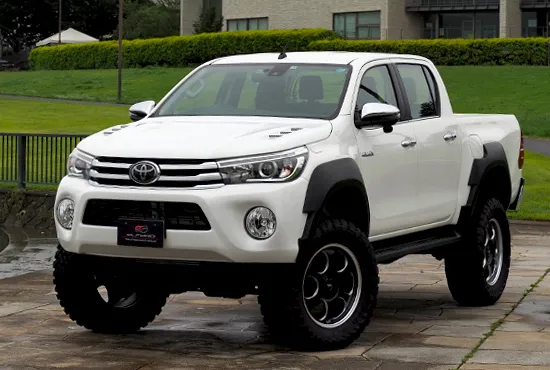
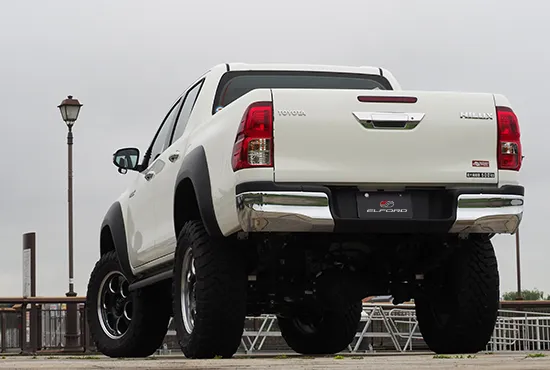
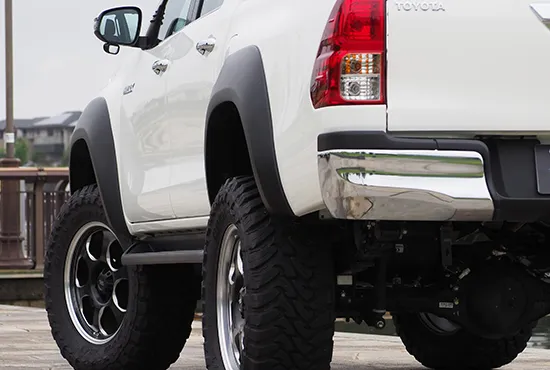
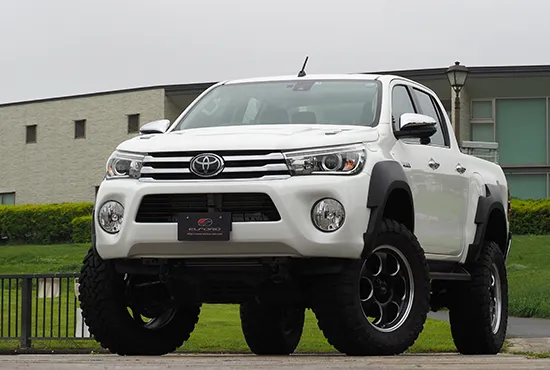
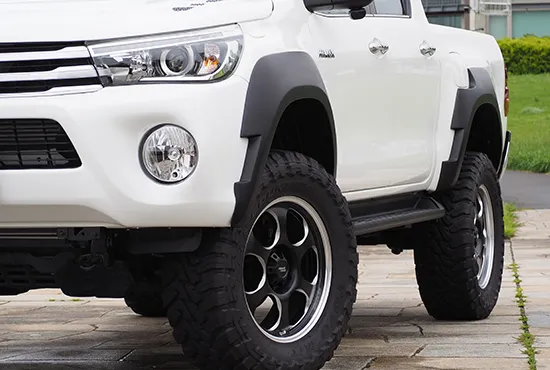
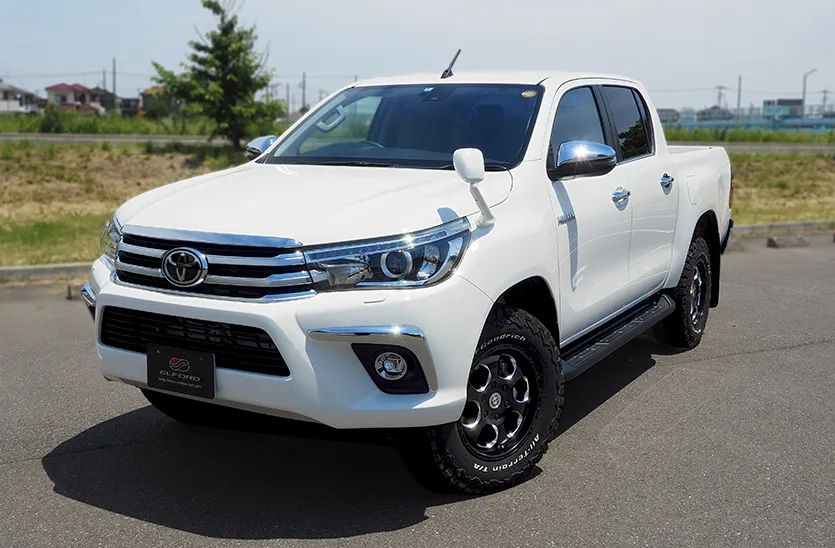
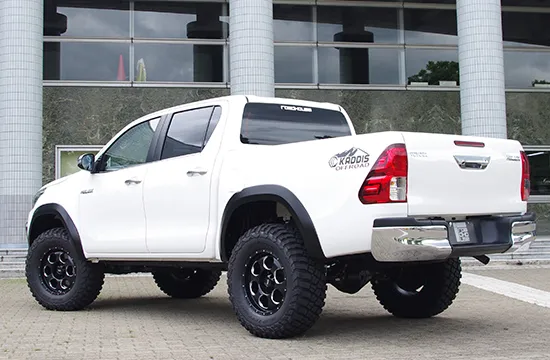
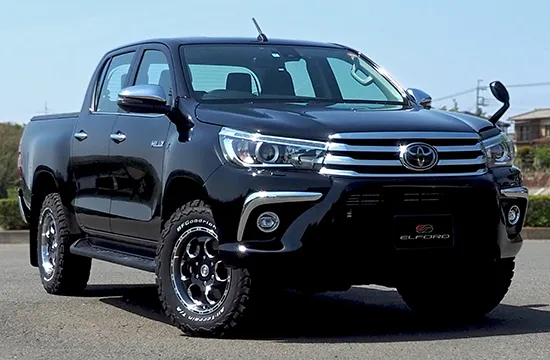
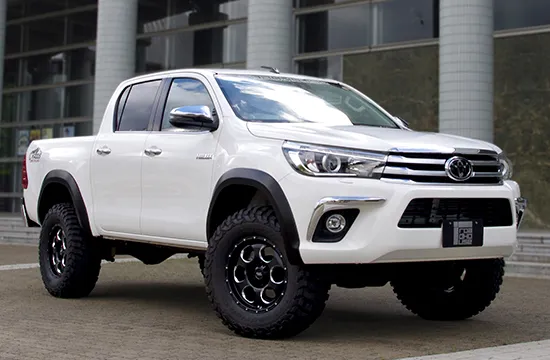
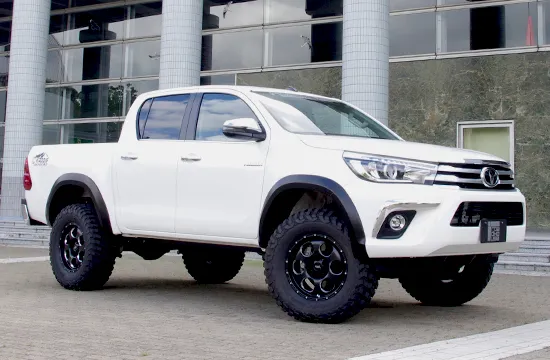
Fender flares are the most popular single body modification for the Hilux, and Promaxx and EGR are the most established manufacturers for the AN120/AN130 platform. Fender flares serve two purposes: they provide the fitment clearance for substantially wider tyres, and they communicate the Hilux's off-road capability visually — the widened arches are now so associated with serious 4x4 builds that they have become a genuine lifestyle signifier in markets from Australia to Russia.
EGR's fender flare programme for the Hilux covers the front and rear arches and fits over the factory paint without drilling in most configurations. The OE Style flare sits flush with the body line for a factory-appearance; the Matte Black series provides a more rugged, functional aesthetic. EGR's fitment accuracy for the AN120/AN130 is excellent — these are purpose-developed for the eighth-generation Hilux rather than generic universal flares. Promaxx's wider flares (80 mm per side) are the choice for owners running 285 or 305 all-terrain tyres and requiring maximum arch clearance.
Walkinshaw AT Pack
Walkinshaw Performance — the Australian tuner responsible for HSV-era Holden performance programmes — developed the AT (All-Terrain) pack for the Hilux specifically for the Australian market, where the Hilux is one of the top-selling vehicles and the lifestyle-off-road segment is particularly developed. The Walkinshaw AT Pack covers a revised front bumper with additional under-guard protection, side steps with integrated kick protection, a sports bar over the tub, and a complete AT graphics programme. The Walkinshaw programme is the most coherent lifestyle transformation for the AN120/AN130 — it turns the working Hilux into a credible lifestyle proposition with a recognisable design identity. Available through Hodoor for international markets.
Artisan Spirits
The Japanese premium tuner Artisan Spirits has developed a body programme for the Hilux that takes a very different direction from the off-road-influenced programmes of Walkinshaw and EGR. The Artisan Spirits Hilux kit focuses on aerodynamic elements — front splitter, side skirt additions, rear diffuser, and a roof spoiler — giving the pick-up a street-focused visual presence more commonly associated with performance SUVs than working trucks. It is a niche choice, but for Hilux owners in Japan and the Middle East who specifically want a street-aesthetic rather than an off-road identity, Artisan Spirits delivers genuine quality at high specification.
Prior Design PDX
Prior Design's PDX programme for the Hilux is a widebody conversion adding 40–50 mm per side via bolt-on arch extensions, a revised front bumper with lower lip, and rear bumper extension. The PDX turns the AN120/AN130 into a wide-stance street truck — a direction with strong appeal in the Middle East, where lifted, widened pick-ups on large-diameter wheels have become a distinct aesthetic category. Prior Design's fibreglass construction and documented fitment accuracy for the AN120/AN130 make the PDX a credible programme for owners pursuing this direction.
Ready to tune your car?
Hodoor ships genuine tuning parts worldwide with DDP delivery — no hidden import costs.
Contact us: [email protected]
Wheels for the Toyota Hilux
The AN120/AN130 Hilux runs a 6x139.7 bolt pattern — the universal heavy-duty truck and SUV bolt pattern shared with the Land Cruiser, Prado, Land Rover Defender, and most serious body-on-frame 4x4s. This means wheel availability at appropriate load ratings is excellent across a wide range of brands and sizes. Factory fitments are 17-inch on most markets; the aftermarket upgrade path splits into off-road and street directions.
Off-Road: 17-Inch All-Terrain Setup
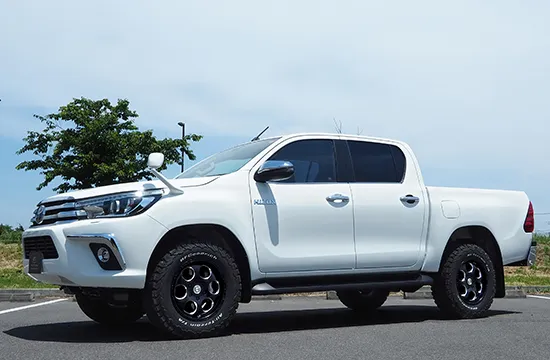
For genuine off-road use, 17 inches remains the correct specification. A 17x9J wheel running 285/70 R17 all-terrain tyres is the most popular combination for serious Hilux builds in Australia and Russia — the 285/70 AT tyre provides meaningful ground clearance improvement, excellent off-road traction, and sufficient sidewall height to absorb impacts without rim damage. Steel wheels are the practical choice for genuine off-road use: they are lighter on the wallet, repairable in the field, and are destroyed less dramatically by rock impacts than alloys. For the combination of off-road durability and alloy appearance, Rays Gram Lights 57DR in 17-inch or the TRD 17-inch alloy are proven options.
Recommended tyre: BFGoodrich KO2 285/70 R17 — one of the most proven all-terrain tyres for serious off-road use. Alternative: Toyo Open Country AT3 285/70 R17 for better on-road manners with comparable off-road performance.
Street / Lifestyle: 18–20 Inch Fitment
For the street-focused Hilux build, 18-inch to 20-inch is the visual upgrade path. The standard street fitment at 20-inch is 20x9J ET0 on a 6x139.7 pattern with 275/55 R20 — this fills the factory arch acceptably and maintains usable ground clearance. With EGR flares installed, 285/55 R20 can be accommodated. Recommended street wheels for the Hilux lifestyle build:
- Fuel Maverick (20-inch) — cast, available in dark tinted or chrome, a popular choice for the lifestyle Hilux in Australia and the Middle East. Strong value for the aesthetic.
- Momo Revenge (18-inch) — alloy, classic multi-spoke design, available in anthracite and silver. Well-priced for a street-focused Hilux setup.
- TRD 18-inch Alloy — TRD's own alloy wheel for the Hilux, compatible with TRD body programme. Factory-quality fitment, TÜV-compatible, maintains warranty considerations.
Performance Upgrades — 2.8 Diesel
ECU Remap to 240 hp
The 1GD-FTV 2.8-litre diesel is one of the most tuneable diesel engines in Toyota's current line-up. Factory output of 204 hp and 500 Nm is conservative relative to the hardware capability — the block, injectors, and turbocharger are all capable of significantly higher output. Stage 1 ECU remapping takes the 1GD-FTV to approximately 240 hp and 580 Nm — a 17% power increase and 16% torque increase with no hardware modification.
The gain profile focuses on the mid-range — 1,600–3,200 rpm — which is the operating range where a pick-up used for towing, payloads, or driving on unsealed roads benefits most. Towing capacity improvement is proportional to the torque increase, and fuel economy at steady motorway speeds typically improves by 8–12% as the engine operates more efficiently in its power band. The 240 hp / 580 Nm figure makes the 2.8-litre Hilux feel genuinely brisk — the character change from the stock calibration is substantial.
Lift Kit — 2 and 3 Inches
A lift kit is the foundational off-road upgrade for the AN120/AN130 Hilux. The most popular specification is a 2-inch lift — Ironman 4x4, Old Man Emu (OME), and Dobinsons all offer complete 2-inch lift packages for the Hilux that include new front coilovers, raised rear leaf spring packs, and updated geometry components. The 2-inch lift provides approximately 50 mm of ground clearance gain and creates the arch clearance needed for 285/70 R17 all-terrain tyres. For more extreme off-road use, a 3-inch lift is achievable with extended shock absorbers and aftermarket lower control arms, though geometry correction at 3-inch requires careful specification.
Bilstein and Old Man Emu Suspension
Bilstein B8 dampers are the benchmark European suspension choice for the AN120/AN130. The B8 monotube design provides superior damping control compared to the factory twin-tube units, particularly under repeated compression cycles on corrugated off-road surfaces — the condition that causes the most driver fatigue on long unsealed sections in Australia, Russia, and central Asia. Old Man Emu (OME) by ARB is the Australian market benchmark — their complete suspension systems for the Hilux are developed and validated in Australian conditions that represent the most demanding real-world test for this type of vehicle. OME systems are available in light, medium, and heavy load configurations, which matters for Hilux owners who regularly carry payloads or tow trailers.
Exhaust Upgrade
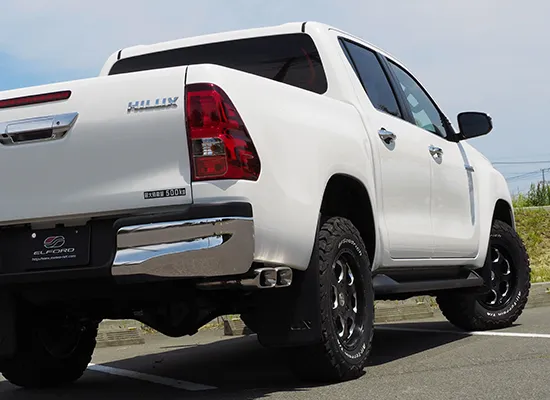
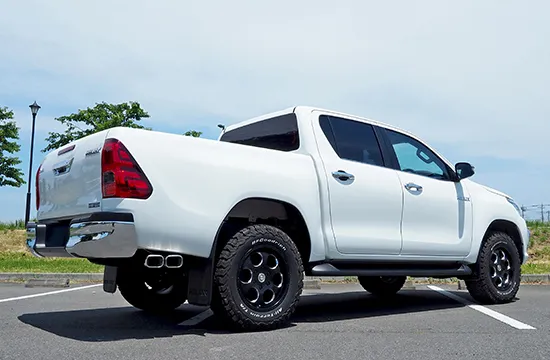
A performance exhaust for the 2.8-litre Hilux provides improved flow at Stage 1 power levels and a deeper diesel tone. ARB's stainless exhaust is designed for the AN120/AN130 platform geometry and maintains ground clearance compatibility with the factory underbody protection. For towing use, the improved flow reduces exhaust gas temperatures at sustained high loads — a practical reliability benefit for Hilux owners who tow near maximum capacity regularly.
Interior Upgrades
The AN120/AN130 interior was a significant improvement over the previous generation, but in the context of the lifestyle transformation market it remains functional rather than premium. For owners who want an elevated interior experience, the aftermarket offers several coherent upgrades.
The most popular interior upgrades for the lifestyle Hilux are a custom leather seat trim — replacing the factory fabric or vinyl with Nappa leather in a contrasting colour scheme — and an upgraded audio system. The Hilux's body-on-frame construction means the cabin experiences more road noise than a monocoque vehicle, and acoustic treatment of the floor, doors, and firewall with STP or similar deadening material is a meaningful comfort upgrade that benefits the audio system as well as general refinement. A secondary popular upgrade is the addition of under-seat storage drawer systems for the dual-cab variant, maximising the utility of the cab floor space for tools, recovery gear, and valuables. These drawer systems are available from multiple Australian manufacturers and fit without modification to the factory floor.
What Actually Changes When You Tune a Toyota Hilux: An Honest Before/After
There is a version of the Hilux tuning conversation that focuses entirely on specifications: 240 hp instead of 204, a 2-inch lift, 285mm all-terrain tyres. Those numbers are real. But what actually changes day-to-day for the owner of a tuned Hilux compared to a stock one? Here is an honest account.
What genuinely changes: The 2.8-litre remap to 240 hp is the single most transformative upgrade on the list. The stock 204 hp Hilux feels like a capable truck; the 240 hp version feels like a fast truck. The difference is most felt when overtaking on a single-lane highway with a full load — the stock Hilux requires commitment and planning, the remapped one simply does it. On the 2-inch lift with 285/70 R17 ATs: ground clearance improves meaningfully, and the psychological effect of the wider, more capable stance is real. You approach rough terrain with more confidence, not only because the vehicle is actually more capable, but because it looks like something that belongs there.
What does not change: The Hilux is still a truck. The ride comfort on-road with all-terrain tyres is noticeably firmer than stock on-road rubber. The turning circle does not improve. Fuel economy with 285 ATs declines relative to the efficiency gains from the remap — the remap's fuel efficiency benefit is largely offset at higher tyre widths. The tub is still the same size, and the cab is still the same interior.
The honest lifestyle transformation: The combination of EGR flares, 20-inch street wheels, and the 240 hp remap genuinely turns the Hilux into a different social object. In the car park of a city restaurant, the tuned Hilux communicates something the stock version does not. That transformation is real and intentional — but it comes with a trade-off in off-road clearance (20-inch street tyres are not 17-inch all-terrains) and on-road ride quality. The working Hilux and the lifestyle Hilux are two different briefs. The AN120/AN130 platform accommodates both well — but choosing which brief you are building to is the most important decision before ordering any parts.
Frequently Asked Questions
Is the Toyota Hilux 2.8 remap safe with the factory warranty?
ECU remapping on any vehicle outside manufacturer-approved programmes (i.e., not TRD) typically affects manufacturer warranty on drivetrain components. In most markets, the Hilux's 3-year or 5-year warranty can be affected by ECU modifications. The practical reality for most Hilux owners — particularly those operating outside metropolitan areas — is that ECU-related warranty claims are rare, and the reliability record of the 1GD-FTV at Stage 1 power levels is well established in Australia and Russia. If warranty preservation is a priority, the TRD accessories programme is the correct path for performance upgrades. For owners who have passed the warranty period, Stage 1 remapping represents the highest-value single upgrade available for the 2.8-litre platform.
TRD vs EGR fender flares — which fits better on the AN120/AN130?
Both TRD and EGR manufacture flares specifically for the AN120/AN130 Hilux generation. TRD flares match factory paint finish options and are designed to be indistinguishable from a factory upgrade — the OEM aesthetic is the point. EGR's flares are available in OE Style (body-colour compatible) and Matte Black (intentionally non-matching). EGR's Matte Black series in particular has become the visual shorthand for a serious off-road Hilux build — the contrast between matte black flares and the factory body colour is a recognised aesthetic in the market. Both programmes fit correctly; the choice is visual rather than functional.
How much does a complete lifted Hilux build cost through Hodoor?
A complete built specification — Walkinshaw AT pack body kit, EGR matte black flares, 17-inch alloy wheels with BFGoodrich KO2 285/70 R17 tyres, 2-inch Ironman lift kit, and 2.8-litre ECU remap — typically prices in a range of USD 8,000–12,000 for parts, depending on market and specific specification. DDP delivery from Hodoor to Russia, Kazakhstan, or Australia means this is the all-inclusive cost. Contact [email protected] with your Hilux's VIN and a description of your intended use — Hodoor's technical team will provide a complete itemised quote with confirmed fitment for your market and specification.
Does Hodoor ship Hilux parts to Australia?
Yes. Australia is one of Hodoor's primary markets for Hilux parts — the Hilux is one of the top-selling vehicles in Australia and the lifestyle off-road build culture is deeply established there. Hodoor ships DDP to all Australian states from the Dubai hub. Transit time to eastern Australia is typically 10–14 business days. For complete body kits and lift kits, palletised freight is arranged directly to your specified workshop address. Contact [email protected] for a current shipping quote to your Australian state and postcode.
Ready to tune your car?
Hodoor ships genuine tuning parts worldwide with DDP delivery — no hidden import costs.
Contact us: [email protected]