
Toyota Land Cruiser 78 (J78 Troop Carrier) Tuning Guide 2026 — Body Kits, Wheels & Performance


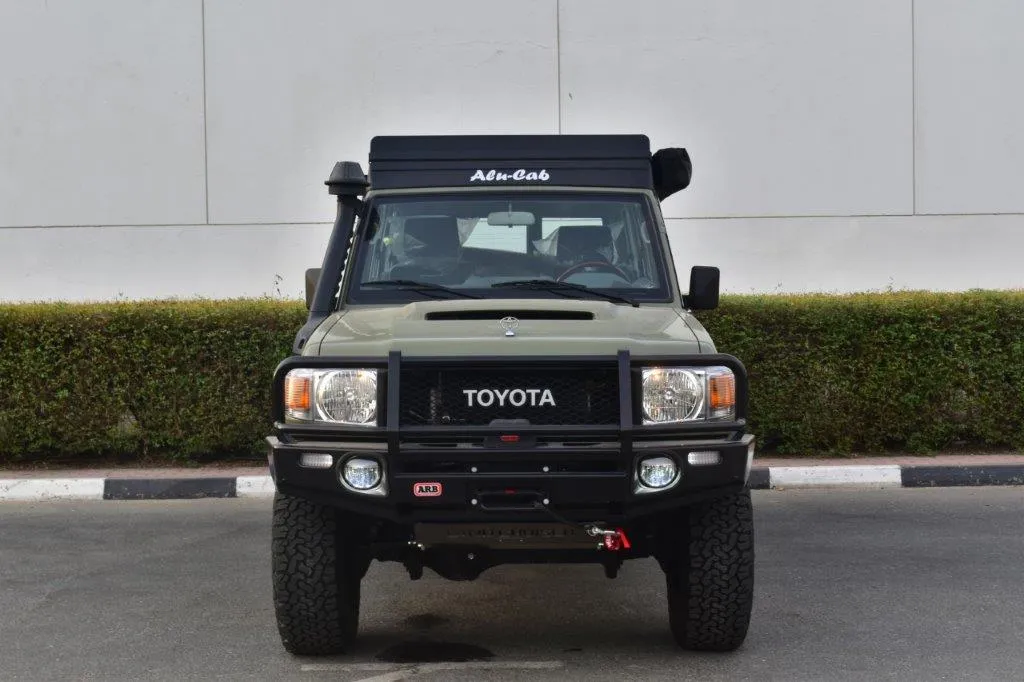
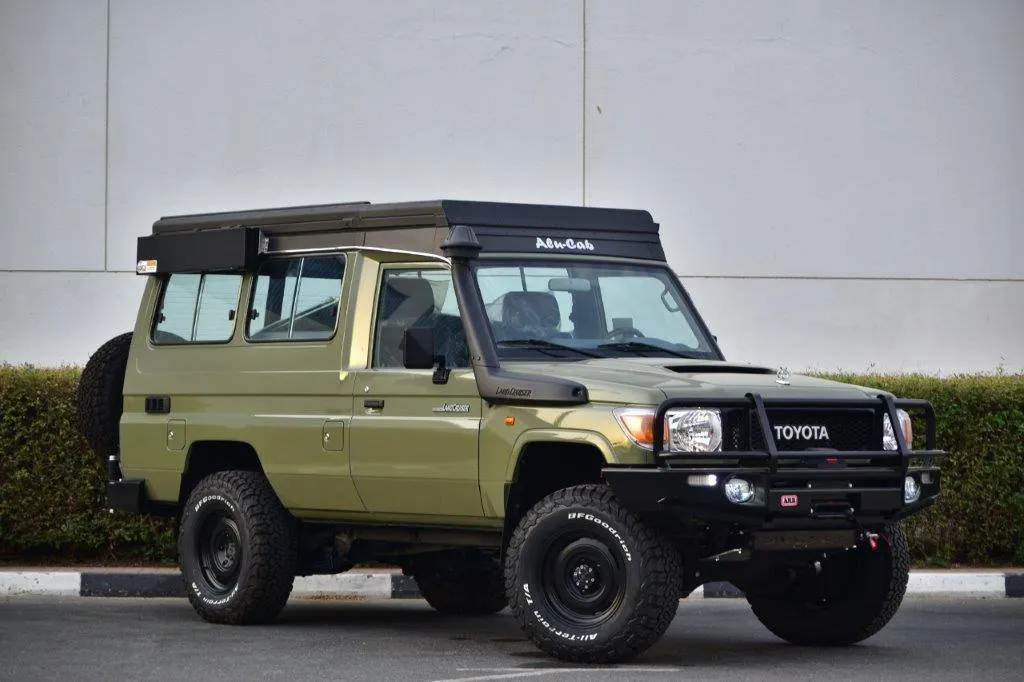
The Toyota Land Cruiser 78 (J78 Troop Carrier) is the four-door long-wheelbase Troopy variant of Toyota's legendary 70-series family — the longest-running Toyota platform in history, in continuous production since 1984 and still rolling off Toyota's Araco lines in 2026. The LC78 specifically is the Troop Carrier body style: a panel-van-style rear compartment originally designed to seat 11 troops on fold-out side benches, riding the same J70 ladder chassis as the 76 wagon but with a longer roofline, fewer side windows and an enormously adaptable cargo area. It remains the overlander's first choice for serious expedition conversions — from Alu-Cab pop-top campers in the Simpson Desert to fully-kitted Mongolian trans-Siberian rigs, desert troop transports in Saudi Arabia, UN fleet vehicles in East Africa and Trans-Kola expedition builds in Russia. This guide covers every meaningful upgrade available for the HZJ78, HDJ78 and current VDJ78 — suspension, bull bars, snorkels, wheels, diesel engine work and expedition conversions — and explains what actually survives in the field.
Specifications — Toyota Land Cruiser 78 Troop Carrier (J78, 1999–present)
Platform Overview — The J70 Ladder Frame Explained
Before discussing upgrades, it is important to understand what the J70 chassis actually is and why the Land Cruiser 78 Troop Carrier has survived 40+ years in production while every unibody rival has come and gone. The J70 platform debuted in November 1984 as the replacement for the 40-series — it introduced a full-length steel ladder frame with boxed rails, a separate bolted-on body, live front and rear axles, and part-time 4WD with a gearbox-driven transfer case retaining genuine mechanical low-range reduction. The J70 chassis is not a spin-off of any car platform; it has no relationship to BMW's CLAR, to Toyota's TNGA, or to the Prado 150/250 GA-F. It is a dedicated purpose-built work 4x4 architecture.
Within the J70 family, several body styles share the same frame: the 75-series was the earlier utility and RV (HJ47/HZJ47 heritage goes back to 1984); 76 is the five-door wagon; 78 is the four-door long-wheelbase Troop Carrier you are reading about; 79 is the single-cab pickup and double-cab ute. The 78 and 76 are both coil-sprung at both ends (passenger-oriented), while the 79 uses leaf-sprung rear axles for load-carrying. The Troop Carrier 78 shares the wagon's long 3180 mm wheelbase but extends the body rearward into a panel-van configuration that is the preferred base for full-height standing conversions, Alu-Cab poptops, and overland living quarters. No other 4x4 currently in production offers this combination of coil-sprung comfort, enormous cargo volume, and body-on-frame durability.
Suspension Upgrades — OME BP-51, Bilstein, Dobinsons & Tough Dog
Suspension is the single most-upgraded component on every Land Cruiser 78 outside of factory fleet service. Factory coils and Toyota-OEM twin-tube shocks are deliberately under-damped and under-rated for empty-vehicle ride comfort on a fleet Troopy — fit an overland load of 600–900 kg plus passengers and the factory suspension bottoms out on any corrugation. The global suspension aftermarket for the LC78 is dominated by four players.
Old Man Emu (OME) BP-51 Adjustable — The Reference Upgrade
Old Man Emu is ARB's in-house suspension brand based in Melbourne, and the OME BP-51 remote-reservoir bypass damper is the reference LC78 suspension upgrade globally. BP-51 is a monotube design with separated oil and nitrogen chambers, externally adjustable compression and rebound (24 clicks each), aluminium body for thermal stability at 140 km/h Nullarbor-highway speeds, and a rated service life of 150,000 km before rebuild. A typical 2-inch OME BP-51 lift on a VDJ78 Troopy adds roughly 440 kg of certified payload (GVM upgrade to 3,500 kg), eliminates factory bottoming on Simpson-Desert corrugations, and transforms the empty-vehicle ride from rattly-truck into daily-drivable. BP-51 is expensive (AU$4–5k) but every serious Australian Troopy builder fits it.
Bilstein 5100 / 5125 — OEM-Ride Monotube
Bilstein 5100 (fixed-length) and Bilstein 5125 (extended for lifted cars) monotube gas shocks are the German engineering benchmark and a very popular European-market alternative to OME for LC78 owners who want OEM-geometry shocks with superior thermal stability. Bilstein's digressive valving prioritises mid-speed body control without the jarring high-speed stiffness of a non-adjustable off-road shock. Typical fitment is a pair of 5100s at factory ride height or 5125s with matching 2-inch coils from Dobinsons or OME — roughly half the cost of BP-51, and a widely accepted overland choice.
Dobinsons Springs & IMS Shocks — Queensland Specialist
Dobinsons (Rockhampton, Queensland) has supplied Australian 4WD coils for over fifty years and manufactures some of the most accurate payload-matched spring rates on the market. The Dobinsons IMS (Internal Metering System) remote-reservoir damper is the direct Australian competitor to OME BP-51 at 60% of the price. Dobinsons' LC78 catalogue is particularly deep on variant-specific spring rates — different coils for the Troopy body vs wagon, different rates for HZJ78 vs VDJ78 front weight distribution, and specific heavy-Troopy rear coils designed for Alu-Cab poptop-equipped conversions.
Tough Dog Suspension — Blue Ocean Ride Control
Tough Dog Suspension (New South Wales) offers the 9-stage adjustable Blue Ocean foam-cell shock as a mid-price alternative to BP-51 and IMS. Tough Dog's compression/rebound adjustability (9 settings via thumbwheel) lets Troopy owners tune the ride to current payload without disassembly — a genuinely useful feature for a vehicle whose GVM varies 400+ kg between empty running and fully-loaded expedition departure. Tough Dog is particularly popular with Kimberley and Pilbara station operators in Western Australia.
ARB Sahara Bull Bar, Old Man Emu BP-51 with GVM upgrade, Harrop ELocker, Safari Snorkel, TJM T15, Ironman 4x4, Bilstein 5125, Dobinsons IMS, Alu-Cab Icarus roof conversion, Front Runner Slimline II roof rack — all authentic, engineering-certified parts shipped direct from Australia, the UAE and Japan. We ship fully-kitted VDJ78 Troopy builds to Russia, Central Asia, the EU, Latin America and East Africa. VIN-verified fitment before every order.
Contact: [email protected]Body Protection — ARB Sahara, TJM T15, Snorkels & Rock Sliders
After suspension, body protection is the next investment priority. An LC78 used in working off-road conditions takes impacts to the front bumper (kangaroos in Australia, camels in the GCC, antelope in East Africa), the underbody (rocks and corrugations), the sills (rock sliders) and the roof (full-length cargo platform). The global aftermarket for LC78 body protection is again Australian-dominated.
ARB Sahara & Summit Bull Bars
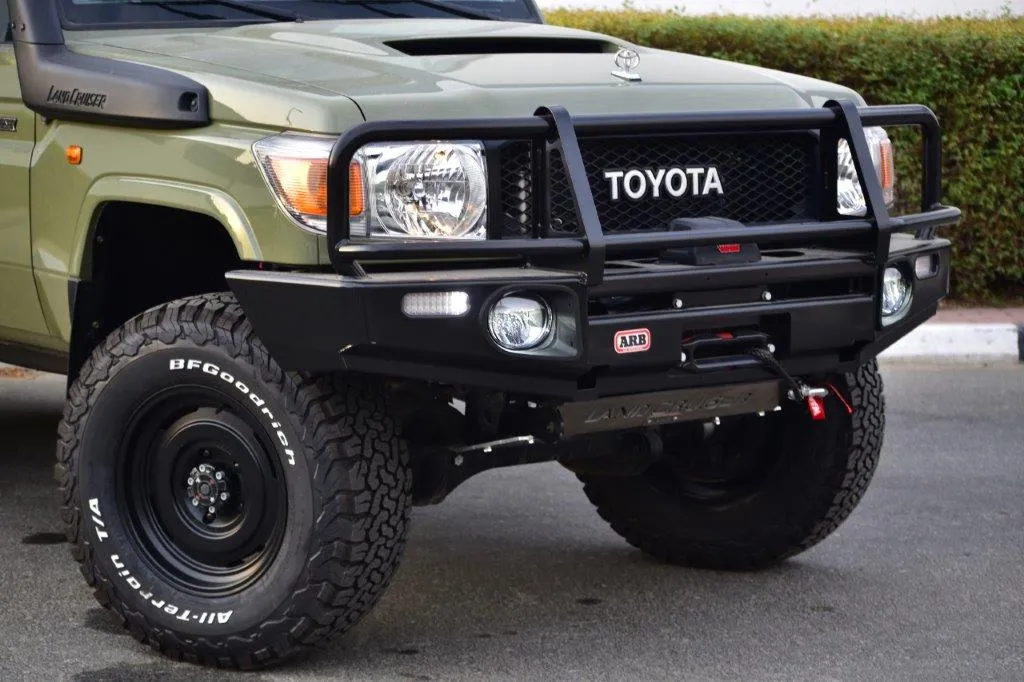
The ARB Sahara Bull Bar is the definitive steel bull bar for the VDJ78 Troopy — airbag-compatible, engineer-certified for ADR compliance, rated to accept a Warn 9.5 XP or ARB 12,000-lb winch, with full headlight and radiator protection against kangaroo or camel strike at 120 km/h. The Sahara uses a classic single-tube hoop design; ARB's newer Summit Bull Bar is a heavier tubular alternative preferred for true expedition work. Both mount winch cradles, aerial bases, CB radio mounts and recovery points. The Sahara specifically is the most-photographed Troopy front bar in the world — it defines the visual identity of the modern LC78 overland build.
TJM T15 Outback & T17 Bull Bars
TJM T15 is ARB's long-standing Australian competitor in the steel bull bar category, lighter than the Sahara by roughly 7–8 kg via a more aggressive tube-section geometry. The TJM T17 is a full-loop alternative with integrated fog and driving light mounts. Both TJM bars are ADR-approved, winch-compatible, and mount the complete TJM recovery-gear ecosystem (Pro Locker, XGS suspension, recovery tracks). TJM owns particularly strong market share in Queensland and Western Australia.
Safari Snorkel Raised Air Intake
Safari Snorkel (now ARB-owned) is the original-equipment raised-air-intake brand. The Safari V-Spec snorkel for the VDJ78 Troopy uses a reinforced polymer pipe with a closed-cell-foam Ram-Head air inlet rated for deep-water crossing, and connects directly into the factory airbox without ECU recalibration. Safari also manufactures the supplementary Armax pre-filter for dust-heavy environments. Snorkel fitment is standard on every Australian, UAE, African and Russian overland Troopy — wading depth rises from the factory 700 mm to approximately 1,100 mm with the raised intake.
Rock Sliders, Rear Bars & Front Runner Roof Platform
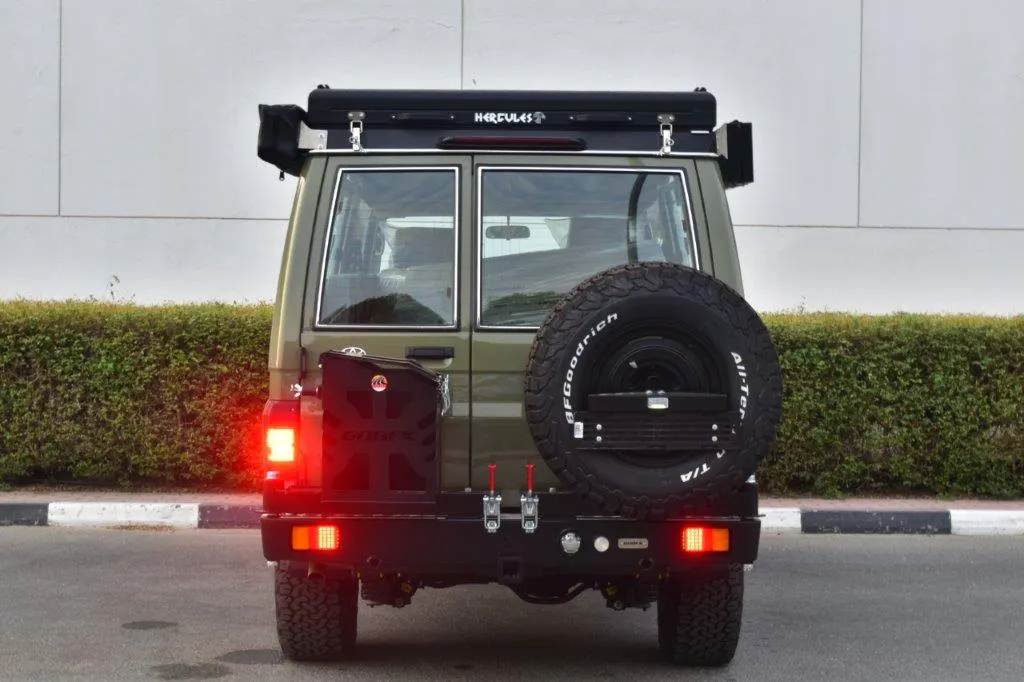
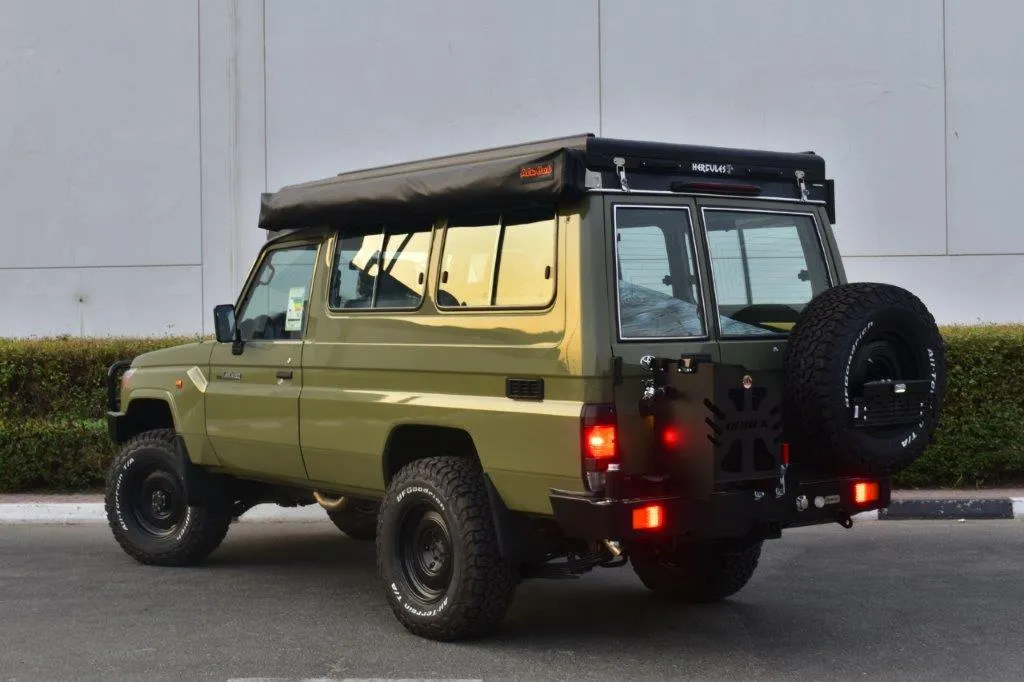
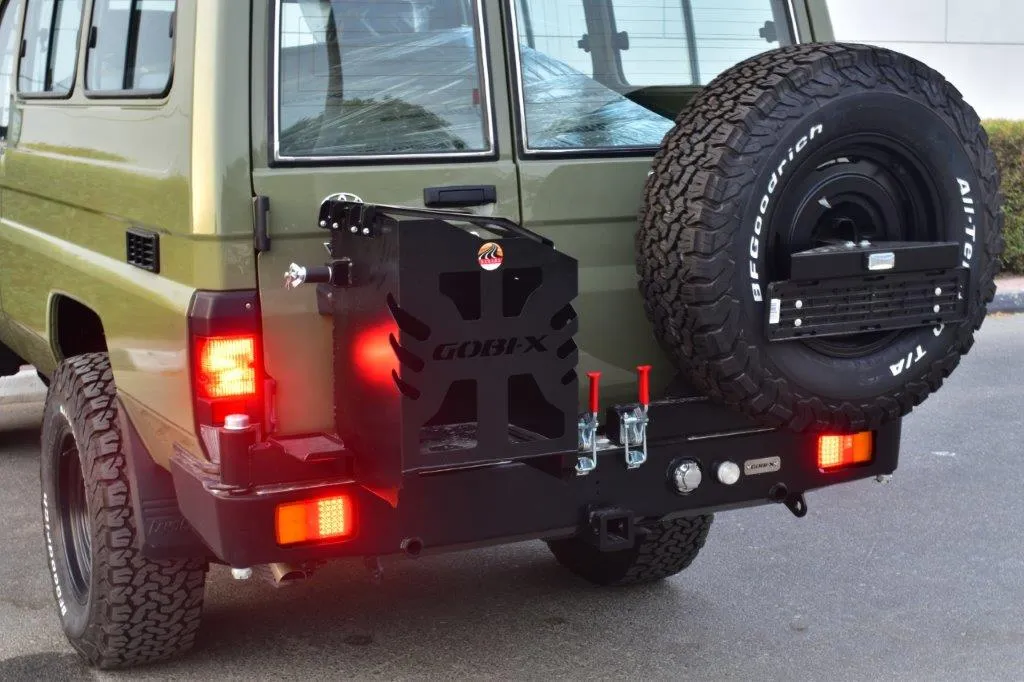
ARB, Outback Armour and ECB manufacture engineer-certified rock sliders (side-step and side-protection combined) that bolt to the J70 chassis rail rather than the body. Rear bars are typically the ARB rear bar with dual wheel carrier, accepting a spare 33-inch tyre on each side — vital on long-range Australian, Russian and African expeditions where a single spare does not provide enough margin. Roof loading is handled by the Front Runner Slimline II platform, the Rhino-Rack Pioneer, or ECB heavy-duty roof rack — all three accept awnings, solar, Maxtrax, jerry cans, rooftop tents and HF-radio masts.
Wheels & Tyres — 16 to 17 Inches, 33" to 35" All-Terrain
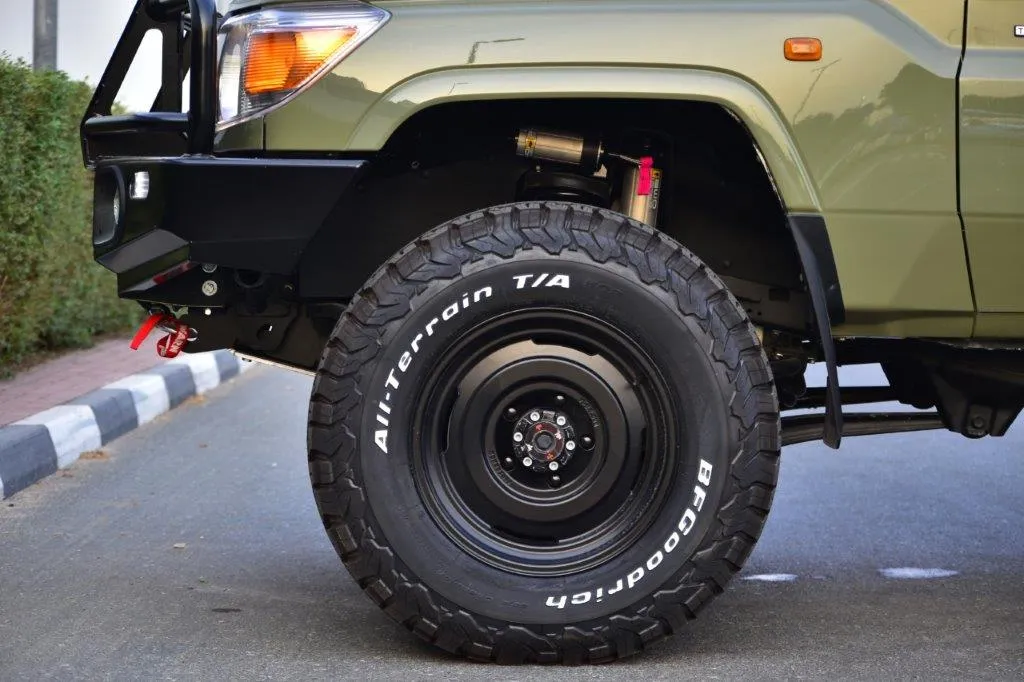
The LC78 uses Toyota's 6×139.7 (6×5.5") bolt pattern with a 106-mm hub-centric bore. Factory fitment is 16-inch steel on the workhorse trim and 17-inch alloy on the GXL Troopy. Crucially: on an LC78 used off-road do not exceed 17-inch wheels — sidewall flex is what lets an all-terrain tyre deform around rocks, soften on sand at reduced pressures, and survive cattle-grid impacts at speed. The consensus global recommendation is 16×8 ET−13 or 17×8.5 ET0 on 33-inch all-terrain rubber.
- Method Race Wheels MR701 Trail / MR305 NV / MR309 Grid / MR105 — Forged or pressure-cast aluminium off-road wheels manufactured in California. MR701 is the lighter variant preferred for long-range Troopy builds; MR305 NV in 17×8.5 ET0 is the US/ME preferred fitment. All accept 33" or 35" all-terrains without arch modification on a 2-inch-lift LC78 Troopy.
- Black Rhino Arsenal & Primm — 17-inch alloy with deep-dish military-style design, very popular for UAE and Saudi Troopy builds. Desert-compatible load ratings and aggressive appearance.
- Walker Evans Racing & Beadlock 17s — Serious desert and dune-running UAE builds fit true beadlock rims at 17×8.5 so tyres can be deflated to 12 psi for sand work without rolling off the rim.
- ARB / OME Steel Wheels 16×8 — The most overland-correct wheel for a Troopy is still a heavy-duty 16-inch steel rim: bendable in a rock strike, weldable in any country with a stick welder, accepting tyre pressures down to 10 psi. ARB black-coated steels are the outback standard.
- Carrec, ROH & Dynamic Alloys — Australian-manufactured aluminium alternatives at lower cost than Method.
Tyre recommendations: the global default all-terrain for the LC78 is the BFGoodrich All-Terrain T/A KO2 in 285/75 R16 (33") — a 40-year-proven all-terrain with aggressive sidewall protection. For more aggressive off-road use the Toyo Open Country M/T or Mickey Thompson Baja Boss in 285/70 R17 or 315/70 R17. For Gulf sand-specific work the Toyo Open Country A/T III or Cooper STT Pro in 285/70 R17. Mongolian, Russian and East African expedition fleets typically run Cooper Discoverer S/T Maxx or Michelin XZL military-grade rubber.
Performance — Steinbauer, Roo Systems & Cobra Exhaust
The Land Cruiser 78 performance conversation is completely different from that of a luxury SUV. Nobody chips an LC78 Troopy to drop tenths at a drag strip — the goal is real-world torque for hauling 3.5-tonne rigs up corrugated tracks, improved fuel economy at overland highway loads, and factory-like reliability at 500,000+ km. Meaningful, clean, warranty-friendly gains are available from a handful of specialist diesel tuners.
VDJ78 1VD-FTV Stage 1 — Steinbauer & Roo Systems (~235–245 hp / 520–550 Nm)
Steinbauer (Austria) manufactures a plug-and-play power module for the 1VD-FTV that delivers approximately +30 hp / +90 Nm over stock — factory 205 hp / 430 Nm becomes roughly 235 hp / 520 Nm with preserved rail-pressure limits, no DPF compromises and no ECU flash required. Steinbauer is the cleanest possible Stage 1 because it is hardware-reversible for warranty or resale. Roo Systems (Queensland) offer the definitive Australian VDJ78 dyno-tuned remap — realistic output after a full Roo ECU flash is approximately 245 hp / 550 Nm, with measured gains across the whole rev range rather than just peak numbers. BlackBox Engineering (Melbourne) and DPChip provide broadly equivalent remap packages.
Cobra Performance Exhaust, Intercooler & Stage 2 (~285 hp / 660 Nm)
Add a Cobra Performance or Manta 3-inch stainless turbo-back exhaust to Stage 1 and the factory DPF (on 2016+ twin-turbo VDJ78 units) can breathe freely enough to support another 10 hp. Beyond that, Stage 2 on the 1VD-FTV combines a larger front-mount intercooler (HPD or Cross Country Performance, critical in 48–55°C GCC ambient), a fuel-pump uprate, and — on single-turbo pre-2016 Troopys — a swap to the factory twin-turbo setup or an aftermarket Garrett GTB2060VK. Output rises to approximately 285 hp / 660 Nm. At this level the factory clutch becomes the weak link; an Exedy or Mantic heavy-duty clutch is mandatory. Stage 2 is the realistic upper limit for a Troopy expected to do 500,000 km of expedition work without rebuild.
HDJ78 1HD-FTE & HZJ78 1HZ — Classic-Era Gains
The 1HD-FTE 4.2L turbodiesel inline-six (HDJ78, 2002–2007) responds exceptionally well to ECU remap plus a front-mount intercooler — 165 hp / 380 Nm factory becomes approximately 210 hp / 500 Nm after a clean Denco or DTS flash with matching intercooler and 3-inch exhaust. The 1HZ 4.2L NA diesel (HZJ78, 1999–2007, and still new-sold in East Africa) remains NA from factory; the definitive upgrade is the DTS Denco turbocharger retrofit kit with uprated injection pump and 3-inch exhaust — output rises from 130 hp / 285 Nm to approximately 170 hp / 420 Nm. This turbo retrofit is the most widely deployed engine mod in the East African LC78 fleet and arguably the most impactful single upgrade available for the 1HZ anywhere in the world.
1GR-FE Petrol — Harrop Supercharger Path
On the 1GR-FE 4.0-litre V6 petrol (primarily Middle East supply), Stage 1 bolt-on intake/exhaust yields approximately 250 hp / 395 Nm. The more interesting route is the Harrop TVS1900 supercharger kit — a fully engineered intercooled positive-displacement supercharger producing approximately 340 hp / 490 Nm with factory-calibrated driveability and factory warranty retention in markets where Harrop has OEM-approved distribution. The Harrop kit is the definitive answer for GRJ78 Troopy owners who want genuinely fast highway performance without sacrificing reliability.
Interior & Troopy Conversions — Alu-Cab, MSA & Black Duck
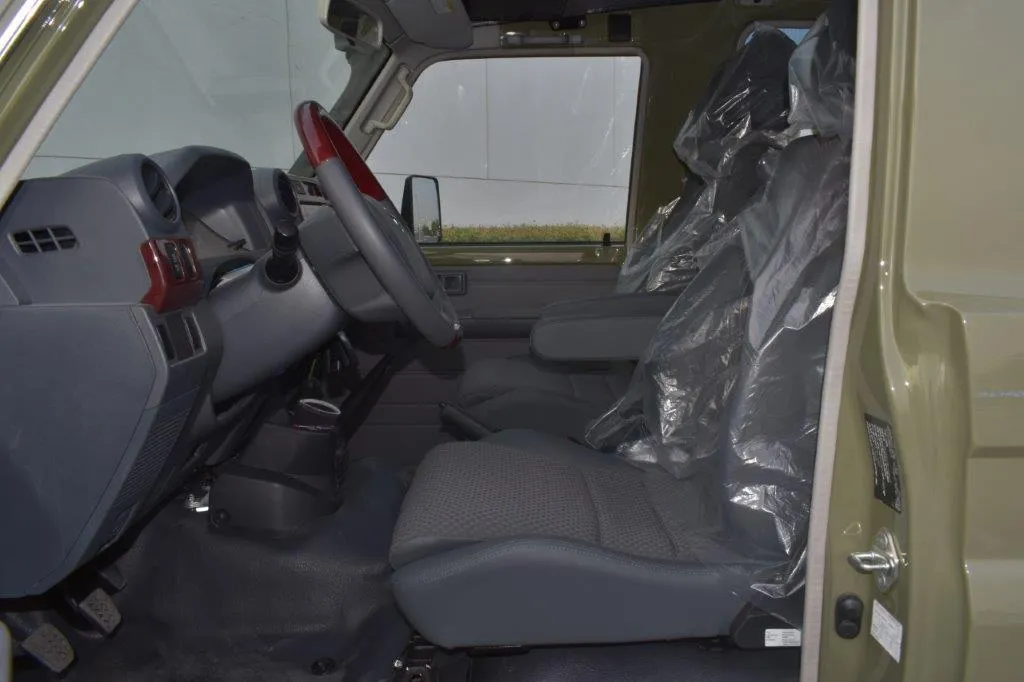
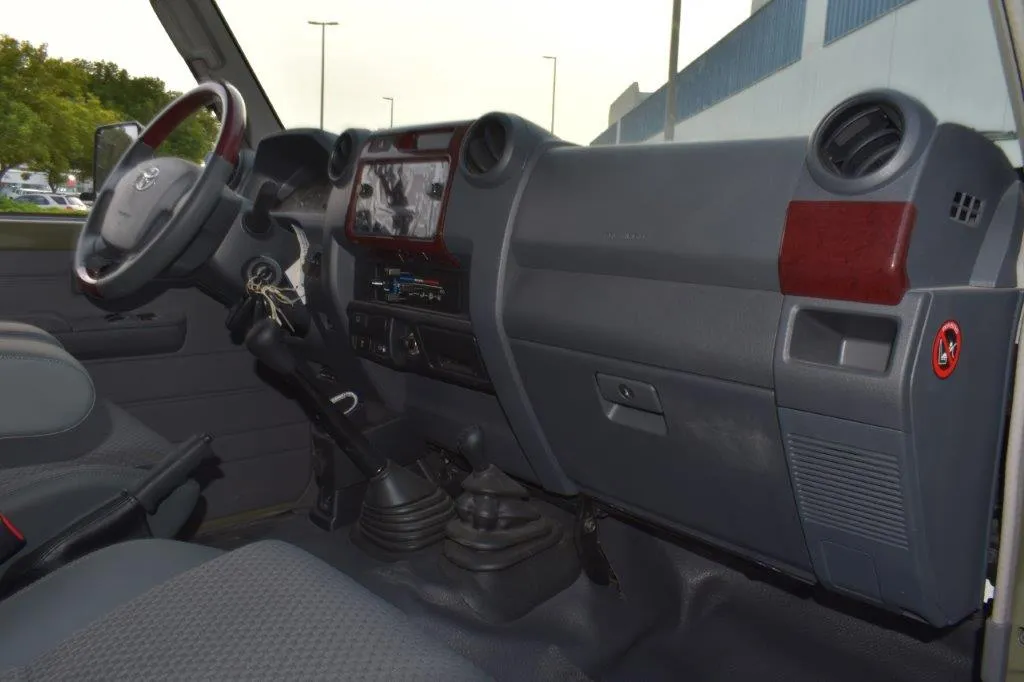
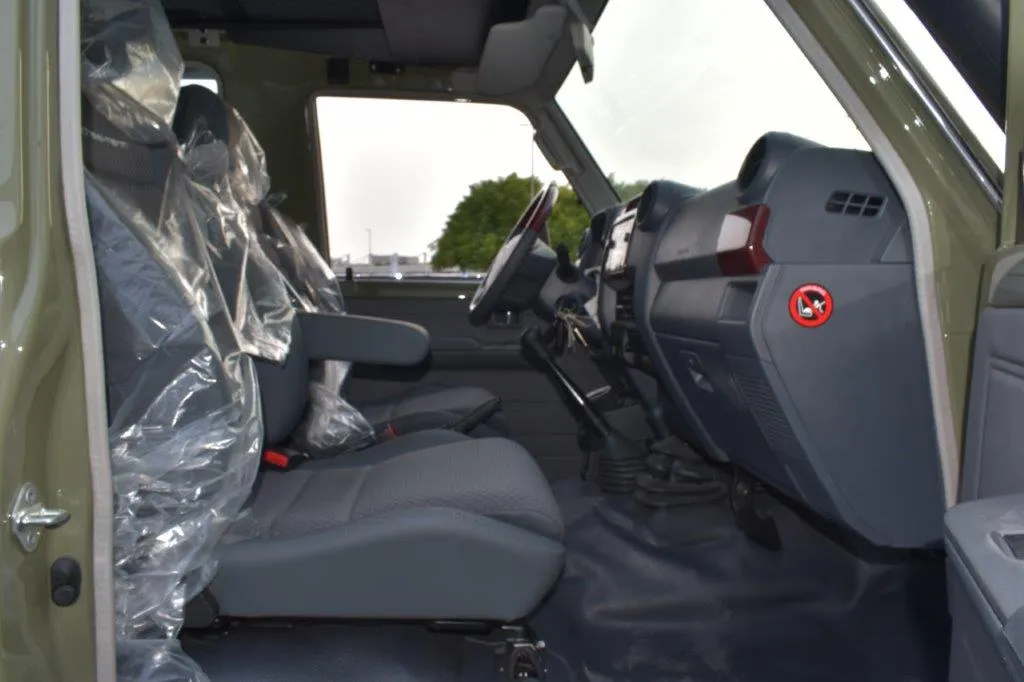
The LC78 cabin is utilitarian by 2026 standards. Where Troopys differ from wagons is the rear compartment — a panel-van-style cargo area designed to seat 11 troops on removable benches. Almost every private-buyer Troopy immediately removes the troop seats and fits an expedition conversion.
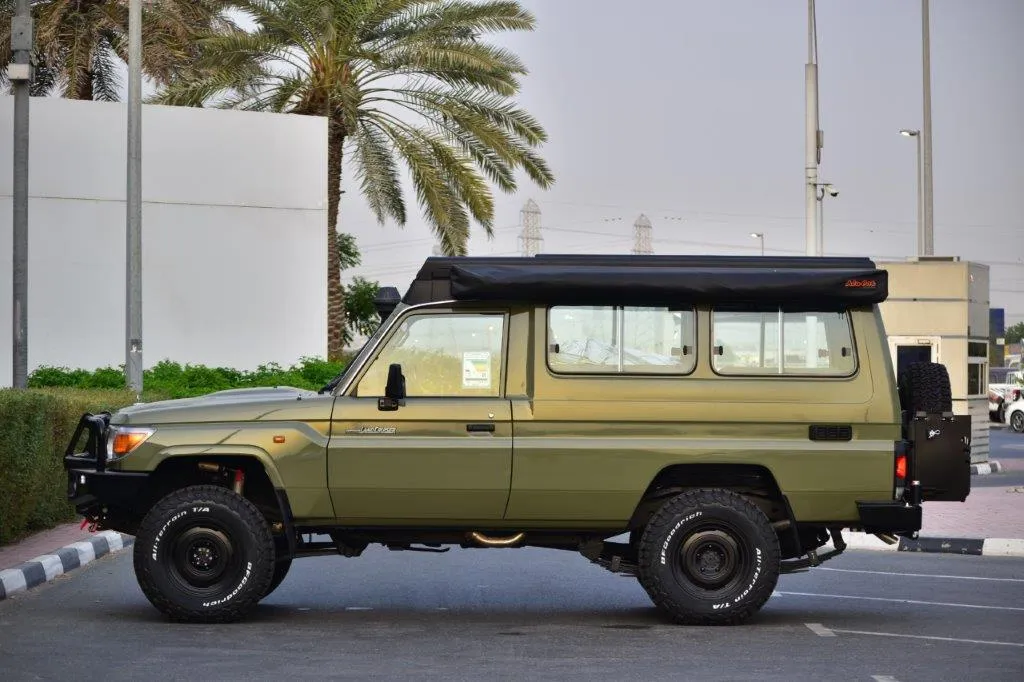
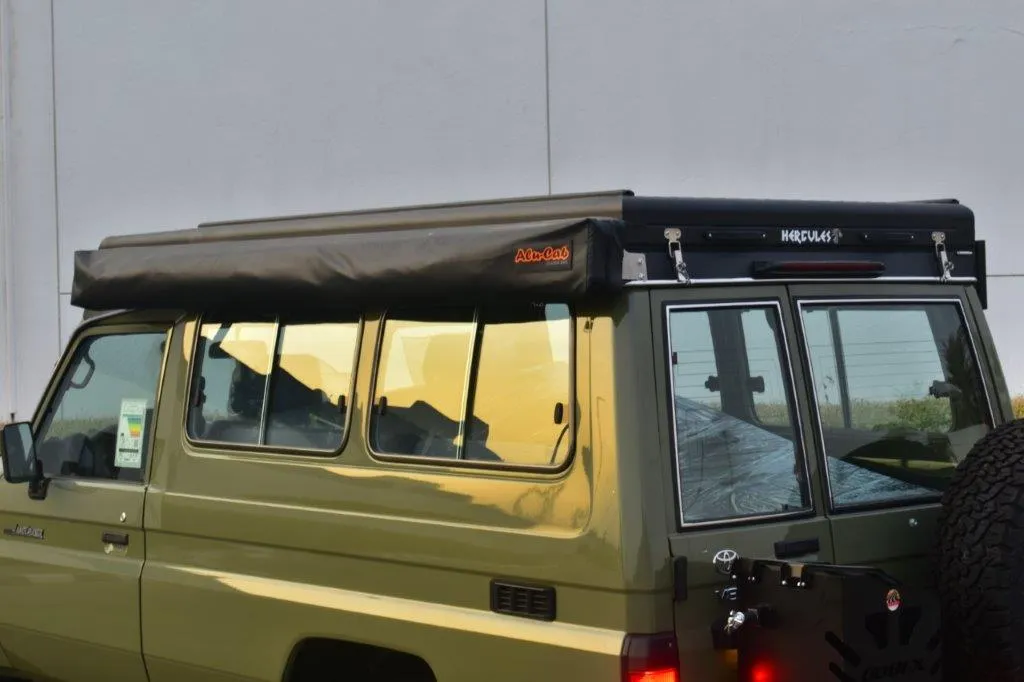
- Alu-Cab Icarus Pop-Top Conversion — The definitive LC78 Troopy conversion: cut the factory roof, bond in an Alu-Cab lift-up fibreglass-and-canvas pop-top with integrated double bed for two adults. Transforms the Troopy into a self-contained camper without external trailer.
- MSA 4X4 / Outback Accessories drawer system — Twin-drawer aluminium storage tailored to the Troopy's extended cargo area, with fridge slide, recovery-gear tray and work surface.
- Front Runner Outfitters Slimline II roof rack & cargo — Full-length aluminium platform accepting awnings, solar, Maxtrax, rooftop tent and jerry cans.
- REDARC BCDC1240D dual-battery DC-DC charger — Smart dual-battery management to run fridge, lighting, inverter and winch from AGM auxiliary without impacting starter reliability.
- Black Duck Canvas seat covers — Heavy-duty canvas covers outlast factory cloth by a factor of five and survive dust, mud, diesel and station-hand abuse.
- Kenwood / Alpine head unit with Apple CarPlay retrofit — The factory LC78 head unit is primitive; a 9-inch Alpine or Kenwood unit with reverse camera and GPS transforms the cabin.
LC 78 By Region — How Use Case Dictates the Build
No other vehicle in the global 4x4 market is built to such radically different specifications on the same chassis as the Toyota Land Cruiser 78 Troop Carrier. The VDJ78 sold in Sydney, Dubai, Moscow and Nairobi shares the same block, gearbox and ladder frame — but the finished vehicles that leave the dealership have almost nothing else in common. Use case dictates the build, and understanding three dominant regional configurations is essential because parts availability, warranty terms and even factory trim options differ by market.
Australia (the overland / 4WD enthusiasts' Troopy): the world's most technically developed LC78 configuration. A typical Australian VDJ78 GXL leaves a Toyota dealership and enters an ARB or TJM workshop the same week, emerging with ARB Old Man Emu BP-51 2-inch suspension and certified 3,500 kg GVM upgrade, ARB Sahara Bull Bar with Warn winch, Safari Snorkel, dual 180 L long-range tank, 33-inch BFGoodrich KO2 on steel rims, MSA twin-drawer cargo system, REDARC dual-battery, 40 L Waeco fridge slide, Alu-Cab Icarus pop-top, Front Runner Slimline II roof rack and Roo Systems ECU remap. Used for Cape York, Simpson Desert, Gibb River Road and Cape Leveque. 5-speed manual strongly preferred — Australian bush mechanics can service it anywhere. Tow-tested to 3,500 kg braked trailer.
Middle East (UAE, Saudi, Qatar, Oman — the desert chrome Troopy): Gulf builds prioritise 50°C-ambient thermal performance, dune-running capability and highway cruising comfort. Typical spec: FOX 2.5 remote-reservoir shocks, uprated HPD front-mount intercooler (factory intercooler thermals are inadequate above 45°C ambient), polished 17-inch beadlock rims (Method or Walker Evans) so tyres can deflate to 12 psi for dune crawls, Toyo Open Country sand-specific rubber, chrome ARB or TJM bull bar, deeply tinted windows, auxiliary rear evaporator for the troop-seat area, roof-mounted LED light bars, premium Focal audio. Recovery gear is present but less prominent — in the Gulf the Troopy is a touring and prestige vehicle first.
Russia, CIS & Africa (the utilitarian fleet / expedition Troopy): the most purposeful of the three. Russian builders specify LC78 for Trans-Siberian, Kola Peninsula, Magadan and Mongolian crossings; the build emphasises basic ARB Deluxe Bull Bar, Safari Snorkel, Bilstein 5125 shocks, dual spare-wheel carrier, long-range fuel, and absolute focus on diesel reliability and parts availability — often running 1HZ or 1HD-FTE engines specifically because they can be rebuilt at any roadside workshop between Ulan-Ude and Ulaanbaatar. African NGO, UN and safari fleets (MSF, WFP, OCHA, Kenya Wildlife Service) deploy HZJ78 Troopys as troop carriers, expedition base vehicles and field hospitals; defining components are 180–280 L long-range tank, roof-mounted sand channels, dual-spare carrier, HF-radio mount, protective grille, rock sliders and a rear-door first-aid rack. No chrome, no polished wheels — everything in the spec is chosen to survive 10-year field deployment.
Frequently Asked Questions
78 vs 76 vs 79 — which 70-series body style should I buy?
The choice between the J70 body styles is fundamentally about intended use. The 76 wagon is the five-door family-oriented configuration: factory rear seats, full side glass, best for passenger touring. The 78 Troop Carrier (this guide) is the four-door long-wheelbase panel-van configuration: a 3180 mm wheelbase with an enormous standing-height rear compartment, by far the best base for overland camper conversions like the Alu-Cab Icarus pop-top. The 79 single-cab is the leaf-sprung pickup/ute — best load-carrier and tow vehicle, but coil-sprung 78 is more comfortable for multi-day driving. For a dedicated expedition-living build the 78 is the unambiguous choice; for passenger-heavy family touring pick the 76; for heavy-haul work pick the 79.
1HZ vs 1HD-FTE vs 1VD-FTV — which diesel engine generation is best?
The 1HZ (4.2L NA inline-six, 130 hp / 285 Nm, HZJ78 1999–2007, still new-sold in Africa) is the most indestructible Toyota diesel ever made — twelve valves, indirect injection, no common-rail electronics, rebuildable with hand tools in any workshop between Dar es Salaam and Bamako. Slow but bulletproof. The 1HD-FTE (4.2L turbodiesel, 165 hp / 380 Nm, HDJ78 2002–2007) is the sweet spot for many overlanders — common-rail 24-valve DOHC with meaningful factory power, responsive, widely remappable, and less complex than the later V8. The 1VD-FTV (4.5L turbodiesel V8, 205 hp / 430 Nm, VDJ78 2007–present) is the current and most powerful option — massive off-idle torque, excellent range on the dual tank, but more complex (DPF on 2016+ twin-turbo). For deep-Africa fleet pick 1HZ; for outback touring pick 1VD-FTV; for a cost-effective balance consider a well-kept 1HD-FTE.
33" vs 35" tyre fitment on the LC78 Troopy?
On a 2-inch OME, Dobinsons or TJM suspension lift, 33-inch tyres (285/75 R16 or 285/70 R17) fit cleanly on the LC78 Troopy without cutting or trimming — this is the recommended default and matches the BFGoodrich KO2, Toyo Open Country M/T and Cooper STT Pro sweet spots. 35-inch tyres (315/70 R17 or 35×12.5 R17) require a 3-inch lift, minor inner-arch trimming on full-lock articulation, extended brake lines and longer bump stops. A 35-inch conversion also requires re-gearing the differentials to 4.88:1 (from the factory 4.30:1) to restore factory-specified acceleration and keep the 5-speed gearbox in its optimal band. Most global LC78 builders recommend 33-inch as the practical maximum; 35-inch is reserved for Gulf dune-running and dedicated rock-crawling configurations, and never exceed 17-inch wheels on an off-road Troopy — sidewall flex matters.
Can I import an LC78 to the UK/EU, and what about non-LCV regulations?
The LC78 is not type-approved for new EU or UK sale because of N1-category and Euro 6 constraints — new VDJ78 Troopys are sold in Australia, ME, Russia, parts of Latin America and Africa but not in western Europe. The practical routes to bring one into the EU or UK are (1) individual vehicle approval (IVA) in the UK on a used imported Troopy, typically 5+ years old; (2) the Netherlands N1 commercial registration channel, which accepts LC78 as a goods vehicle; (3) the historic-vehicle channel after 30 years (HZJ78 built before 1996 qualifies now). Each route has different insurance, emissions-zone access and seat-configuration implications. Contact [email protected] with your destination country, intended use (commercial vs private), and seat configuration preference (2-seat N1 vs factory 11-seat M1) and we can provide complete sourcing, compliance and shipping guidance including ARB, OME, TJM and Safari Snorkel fitment before export.
ARB Sahara Bull Bar & Air Locker, OME BP-51 suspension with GVM upgrade, Harrop ELocker, Safari Snorkel, TJM T15, Ironman 4x4, Bilstein 5125, Dobinsons IMS, Tough Dog Blue Ocean, Method Race Wheels, Front Runner Slimline II, Alu-Cab Icarus pop-top. Stage 1 & Stage 2 ECU (Steinbauer, Roo Systems, DPChip) and Cobra exhaust for the 1VD-FTV V8 diesel — up to 285 hp / 660 Nm. Harrop TVS1900 supercharger for 1GR-FE V6 petrol — 340 hp. Worldwide shipping, VDJ78/HDJ78/HZJ78 VIN-verified fitment, engineering certification included.
Contact us: [email protected]